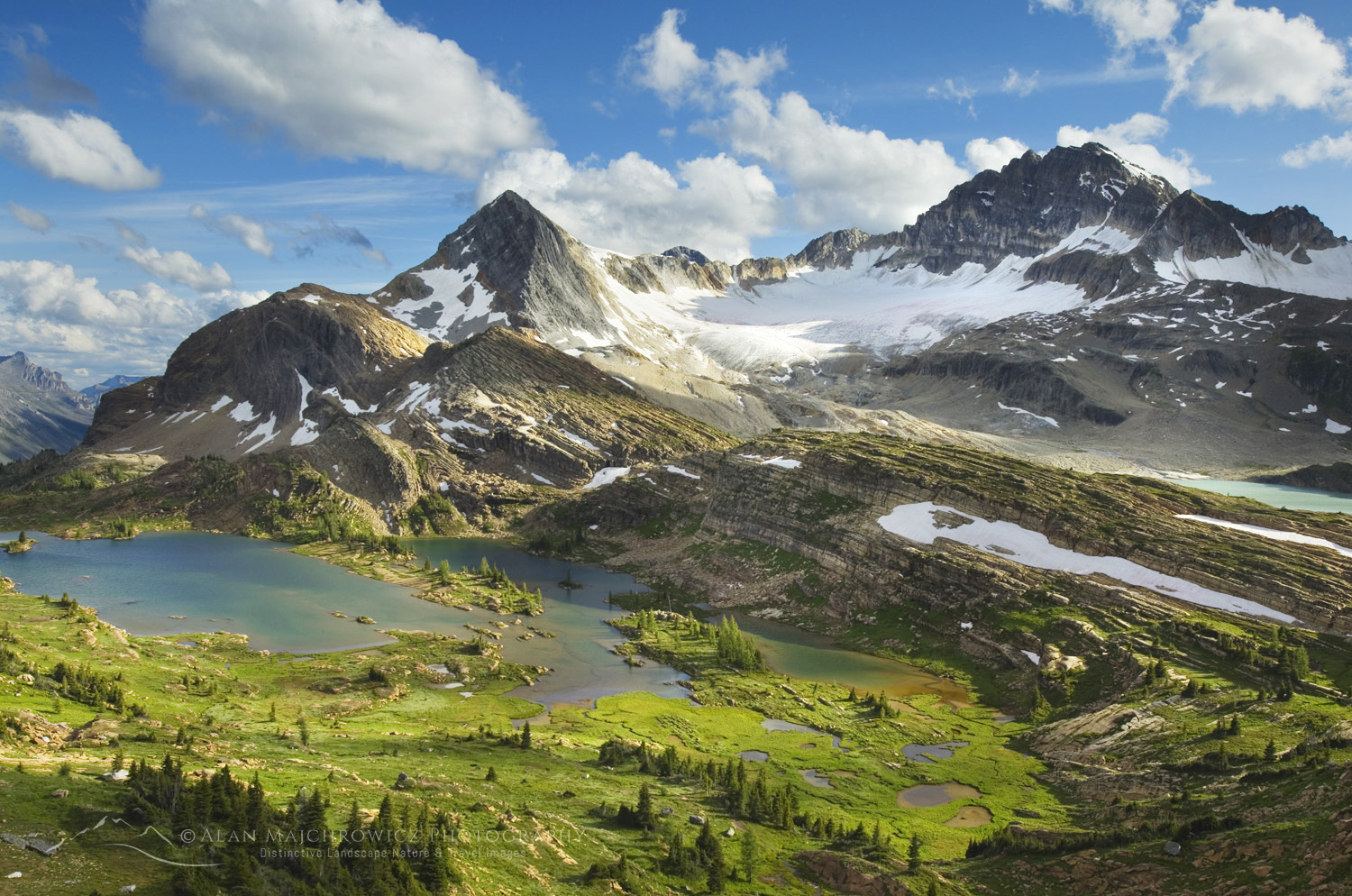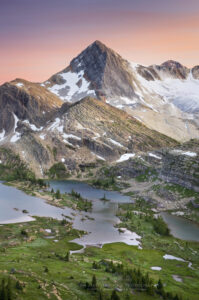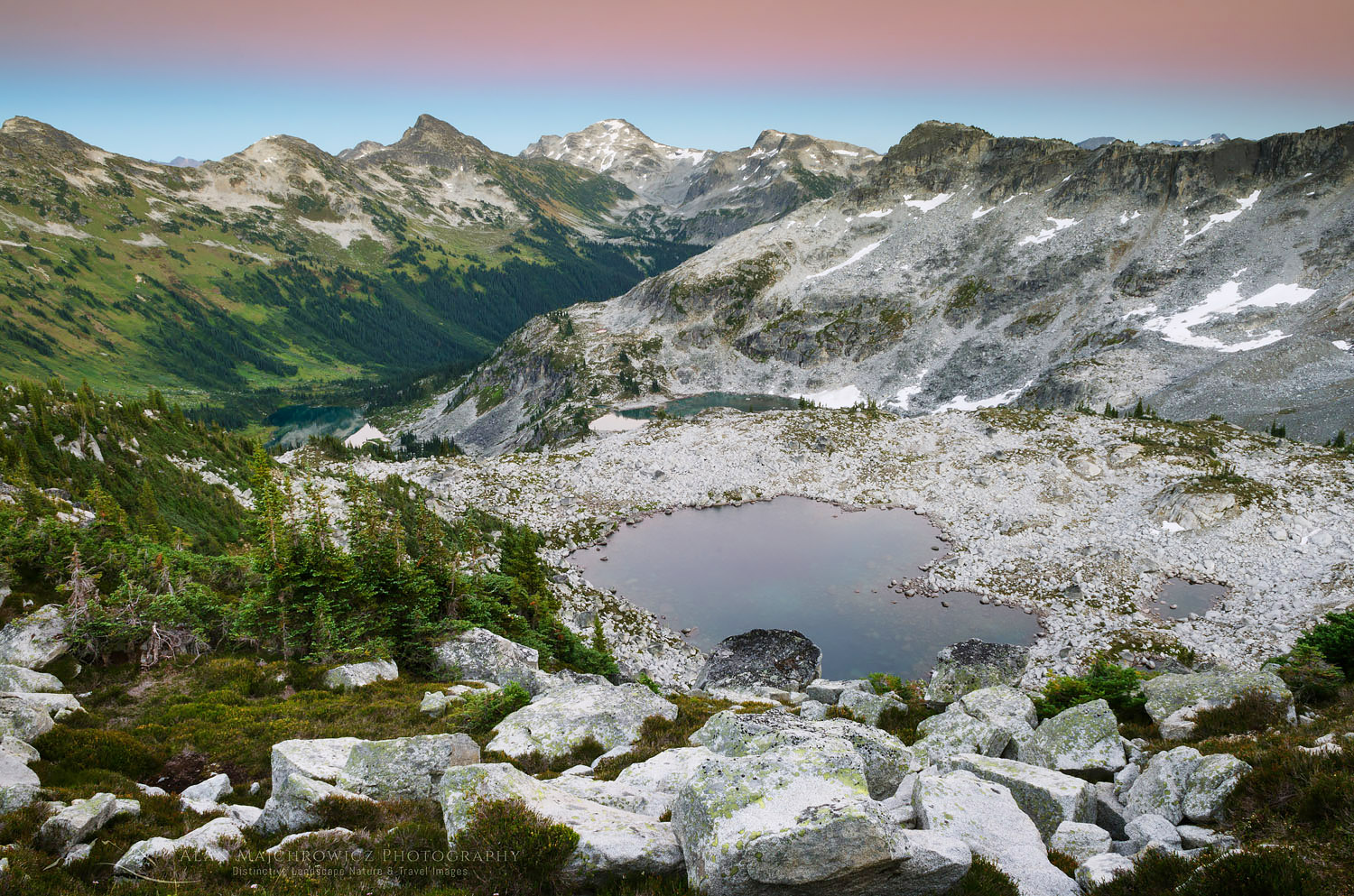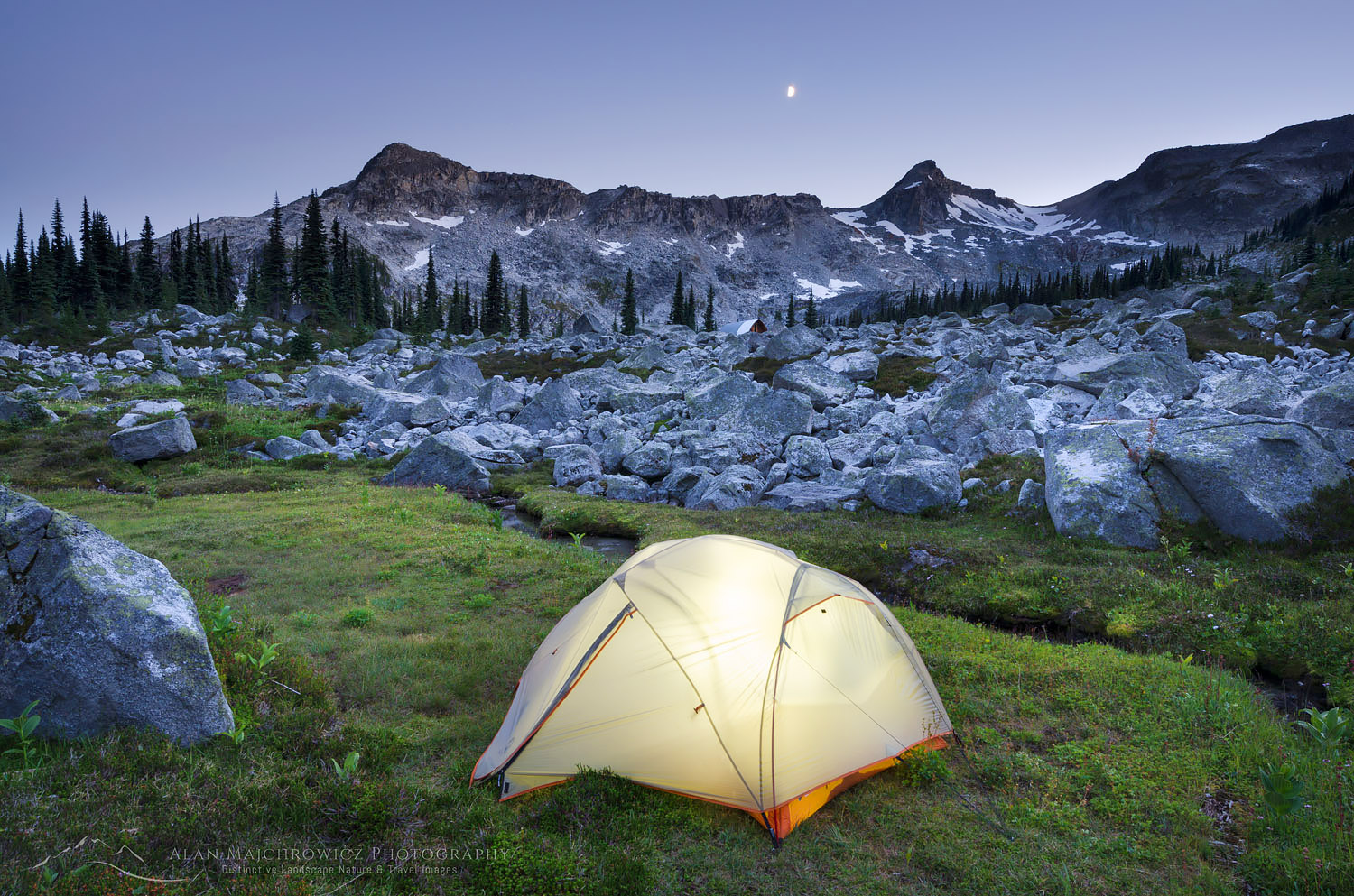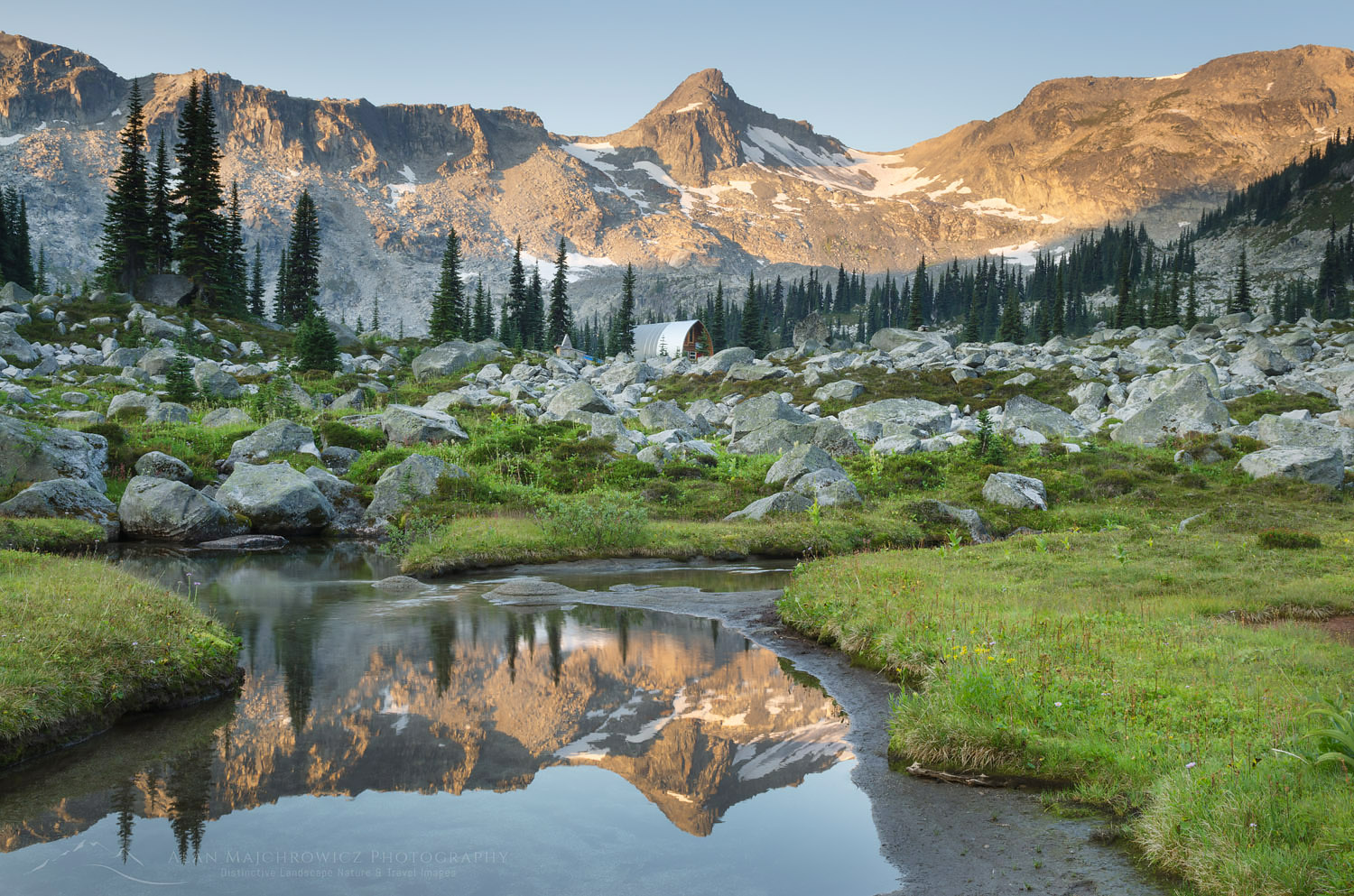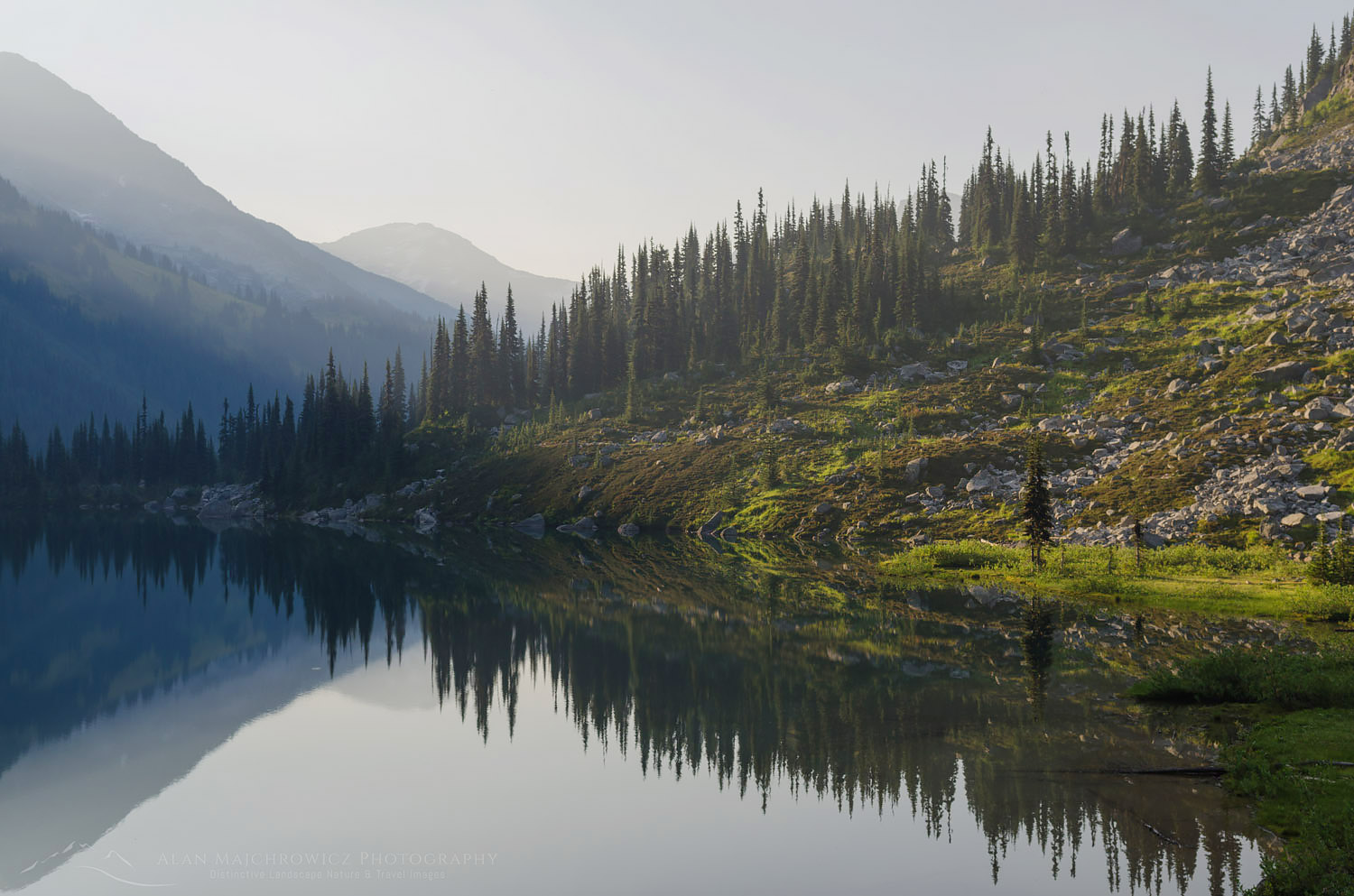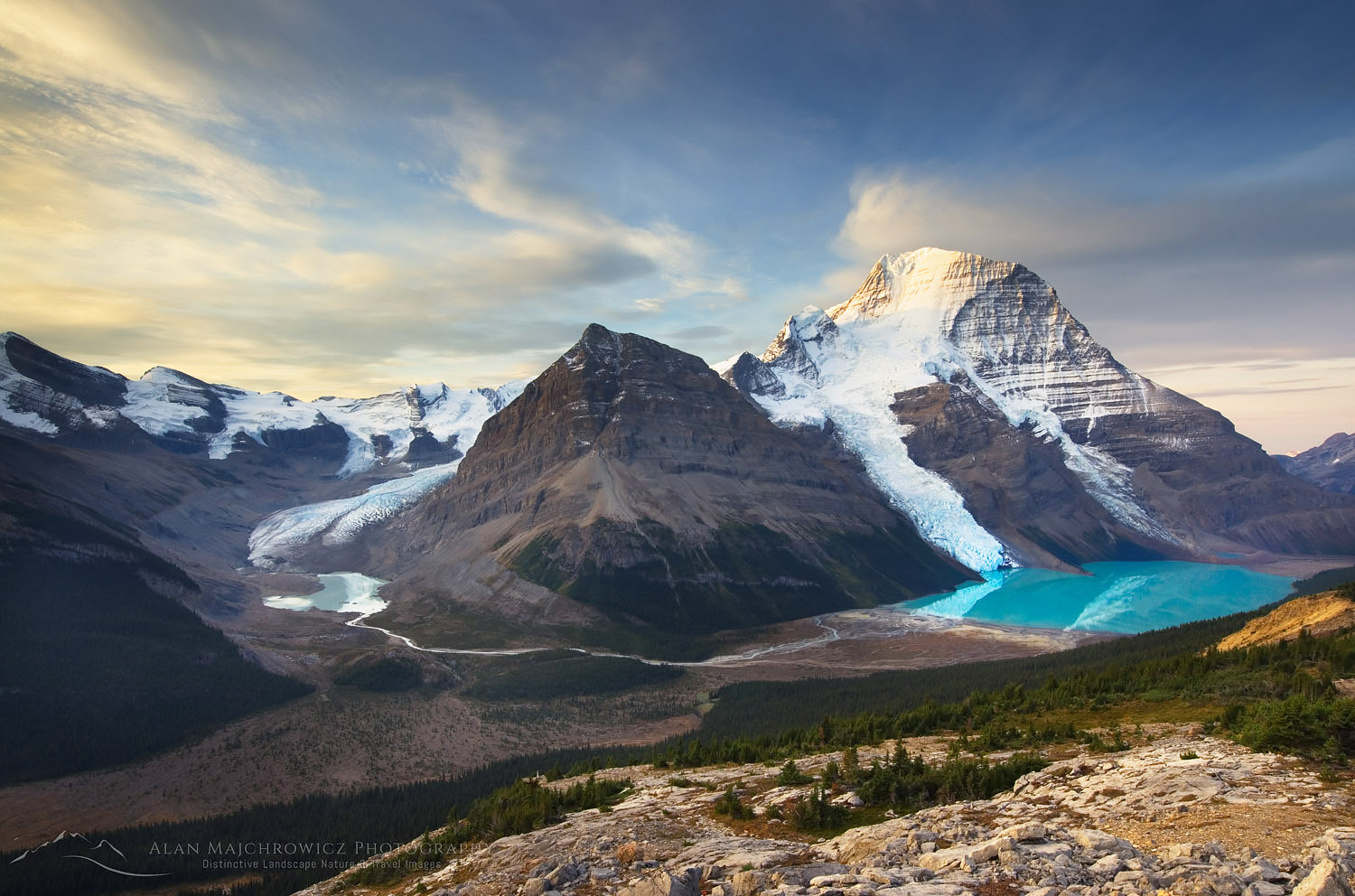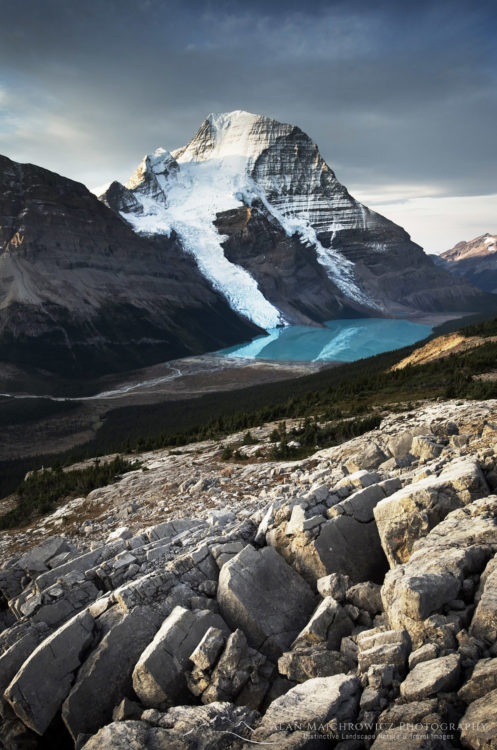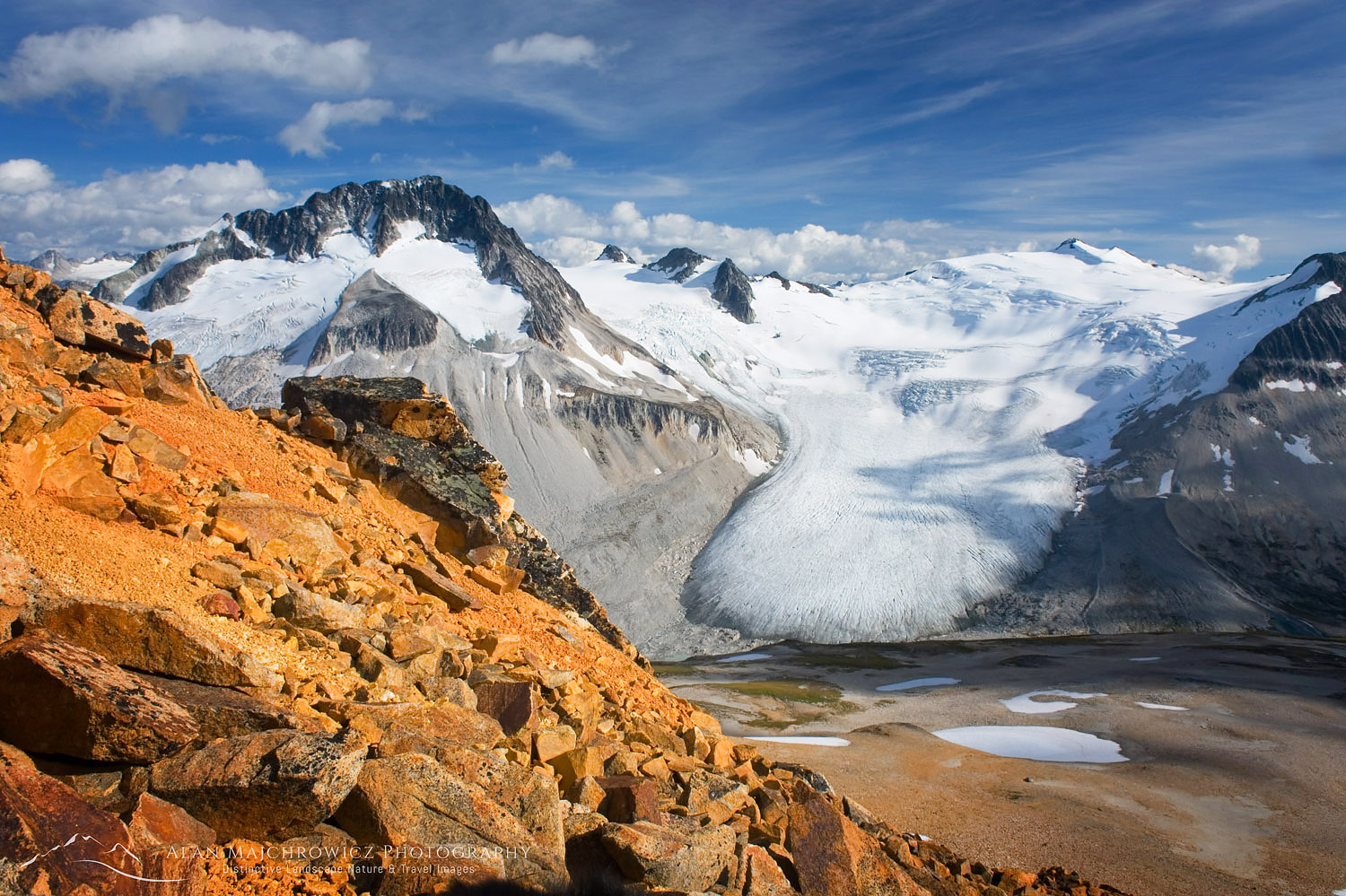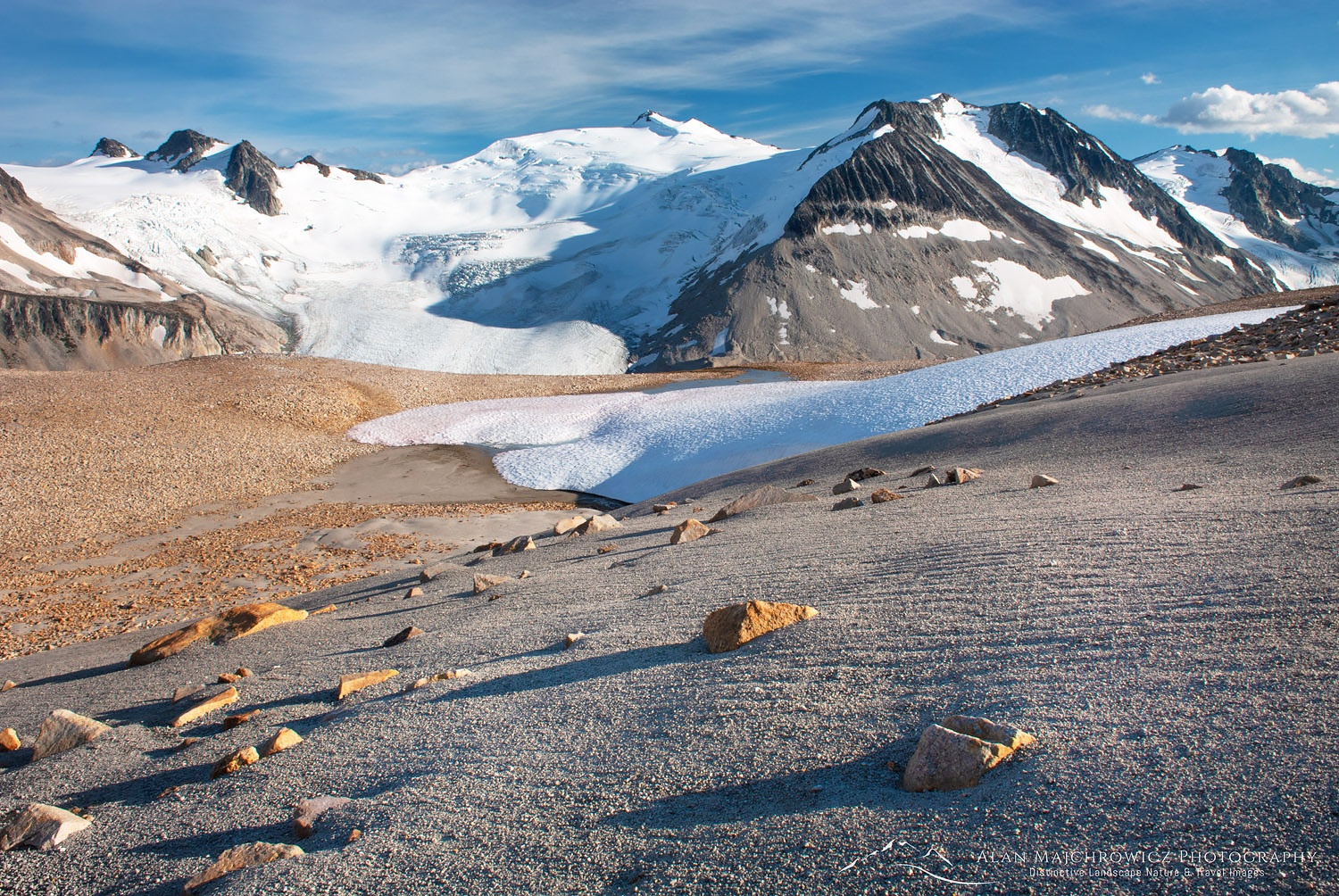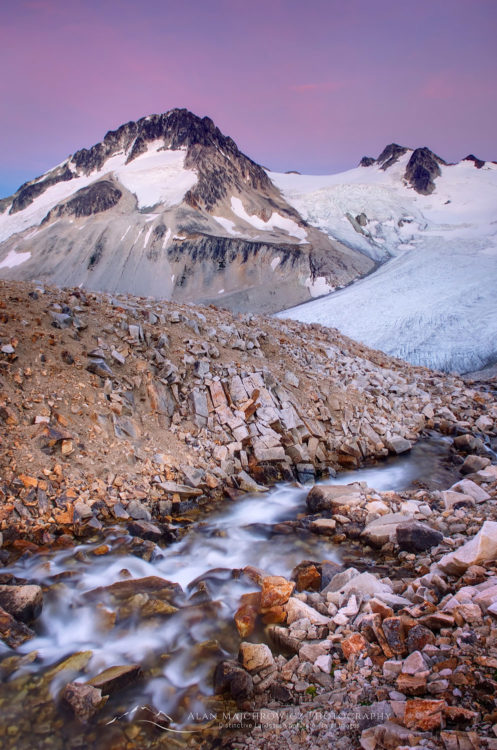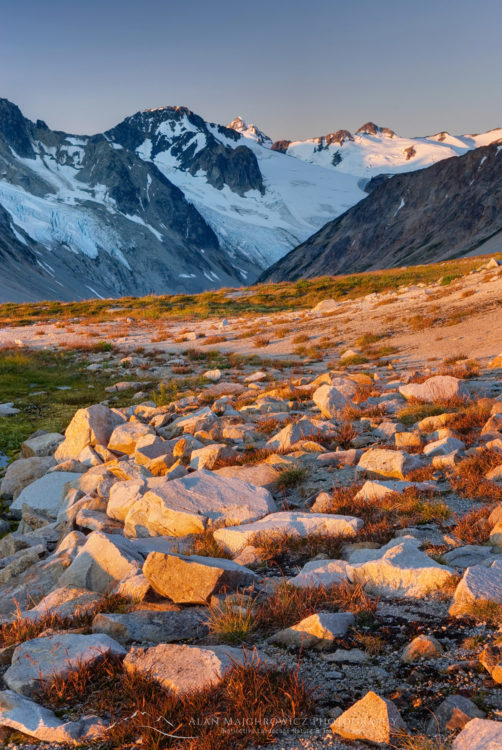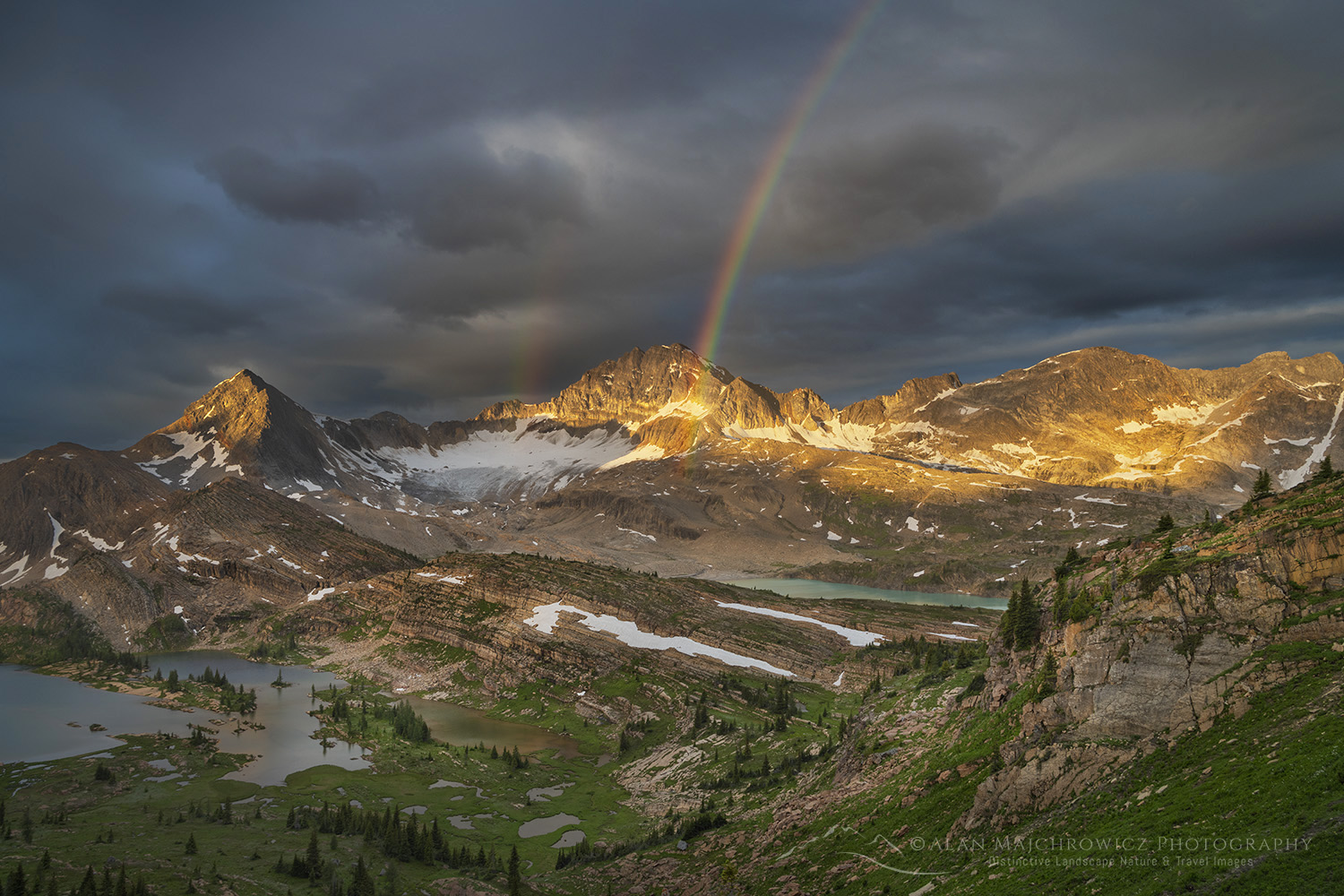
Sunrise rainbow over Limestone Lakes Basin. Height of the Rockies Provincial Park British Columbia

Limestone Lakes Height of the Rockies Provincial Park: Part 2

Sunrise rainbow over Limestone Lakes Basin. Height of the Rockies Provincial Park British Columbia Limestone Lakes Height of the RockiesRainbow over Limestone Lakes, Height of the Rockies Provincial Park #86474  Purchase

Limestone Lakes Height of the Rockies Provincial Park: Part 2

Limestone Lakes Height of the Rockies Provincial Park is one of the few places in the Canadian Rockies where a person can experience true solitude. And, it is also an exception in an era of reservations, lotteries, and fees for backpacking trips. As of 2026, there are no fees, reservations, or even a registration needed for a trip of any length.

Of course, as I mentioned in part one of this series, there are reasons for this. Limestone Lakes is not an easy backpacking destination. And it is too far and involved for a day-hike. However, for those willing to commit at least three days and lots of sweat, it is a dream destination.

So, let’s start the second half of the trip, where part one left off.
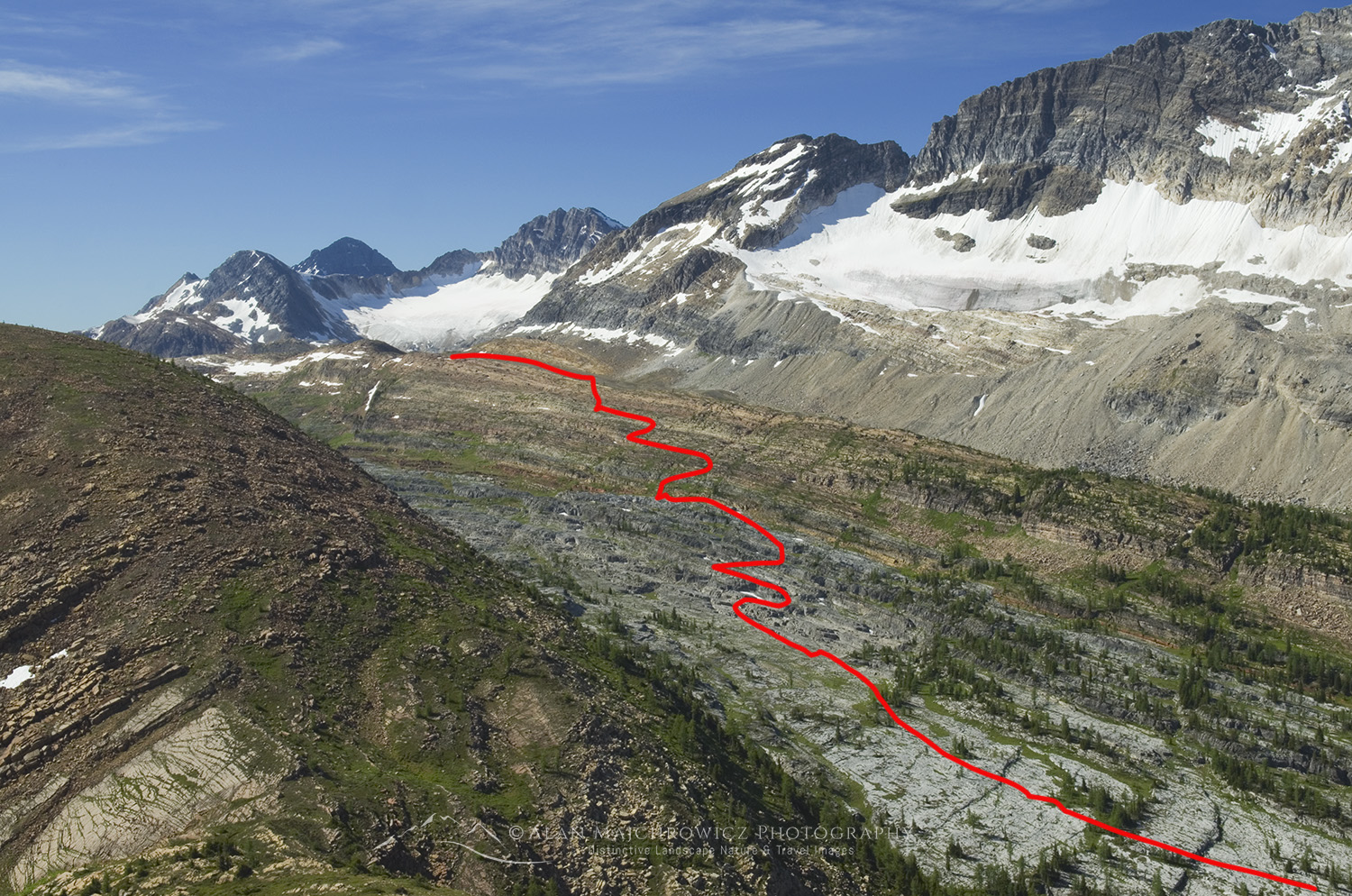
Route to Limestone Lakes Basin, Height of the Rockies Provincial Park British ColumbiaView of the route (red line) from the nub

Limestone Lakes, Cross Country Route-Finding

After leaving Sylvan Pass and ascending to the summit of the 8300′ nub, you get a great view of the route to Limestone Lakes. This is a good spot to rest and take a few moments to commit the scene to memory. Basically, you’ll need

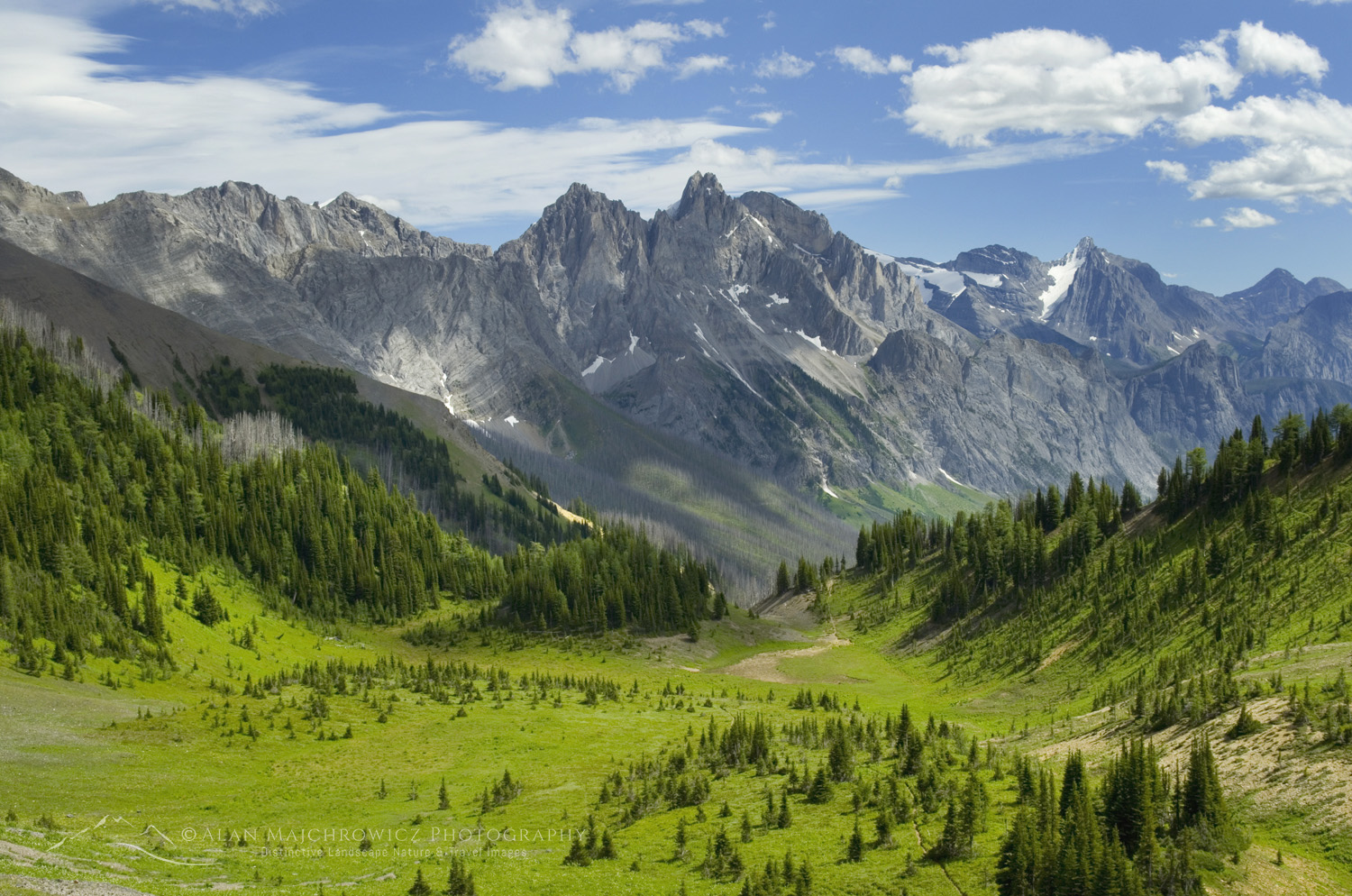
to descend into the open upper valley and travel southwest and over numerous ascending ledges and cliffs to a pass overlooking the lakes basin. The route is always in the open and, using common sense, it is fairly obvious. A GPS can come in handy, but not necessary.

The first difficulty is getting down to the valley. Start descending southwest to a small meadowy pass. There may be faint glimpses of a trail here. Then head west until cliffs bar the way. At this point, you’ll need to find negotiable ledges while heading in a northwest direction. Take your time to scout out the best route. Eventually, the cliffs and ledges become easier, and the valley is reached. About 800′ below the summit of the nub. It’s a bit heartbreaking to realize that all the elevation you just lost will need to be regained again, and more.
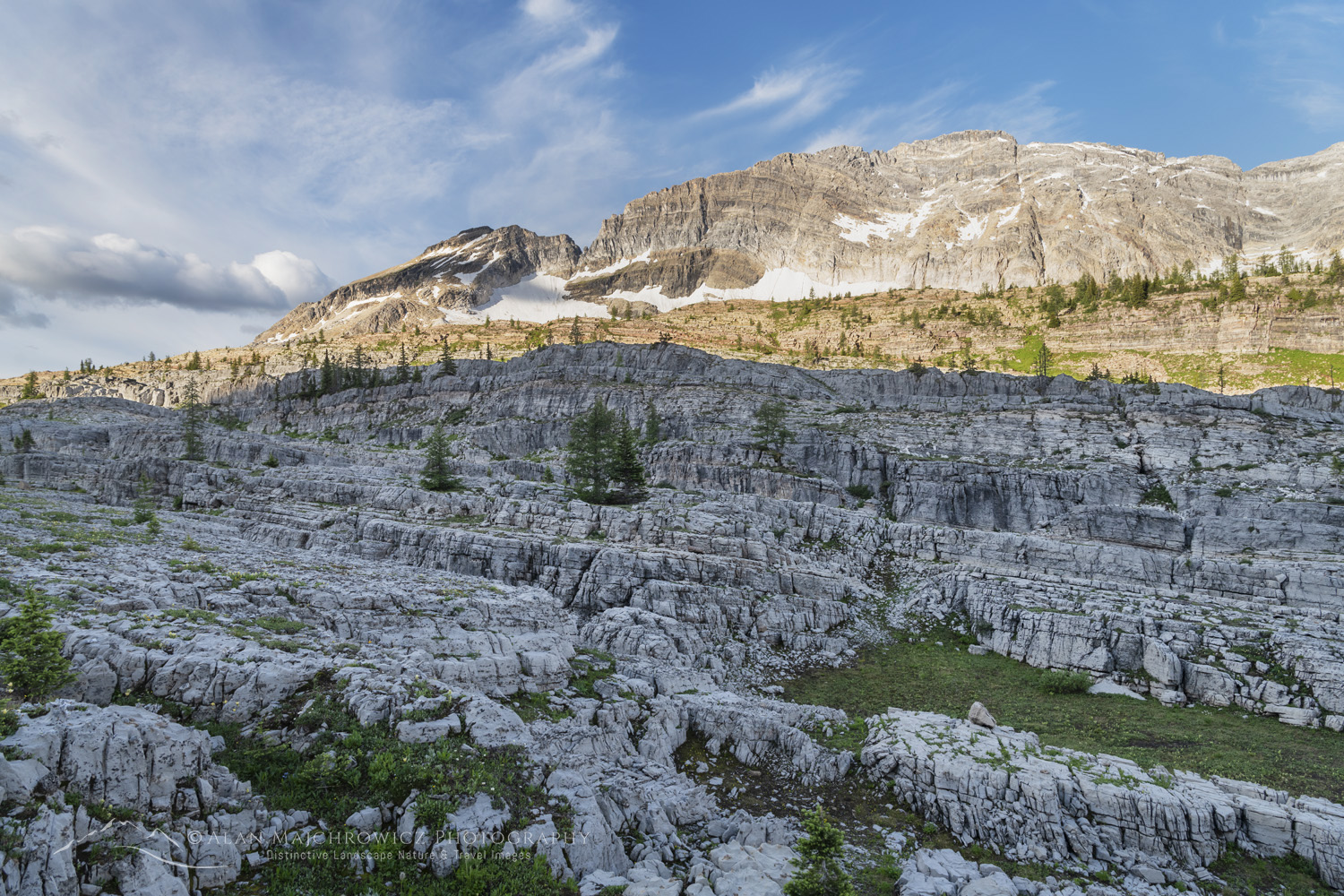
Broken cliffs of limestone Height of the Rockies Provincial Park British ColumbiaLimestone terraces #86598 Purchase

Crossing the Karst Terrain

Once in the valley, it is worth dropping your pack to take some time searching for the start of the alternate route to the Joffre Creek trail on your way out. Here is where a GPS will really come in handy, since it can be very frustrating and time-consuming to find the correct spot. The start of the very faint trail is about where the subalpine meets the forest, and it will travel northeast along the base of the nub.

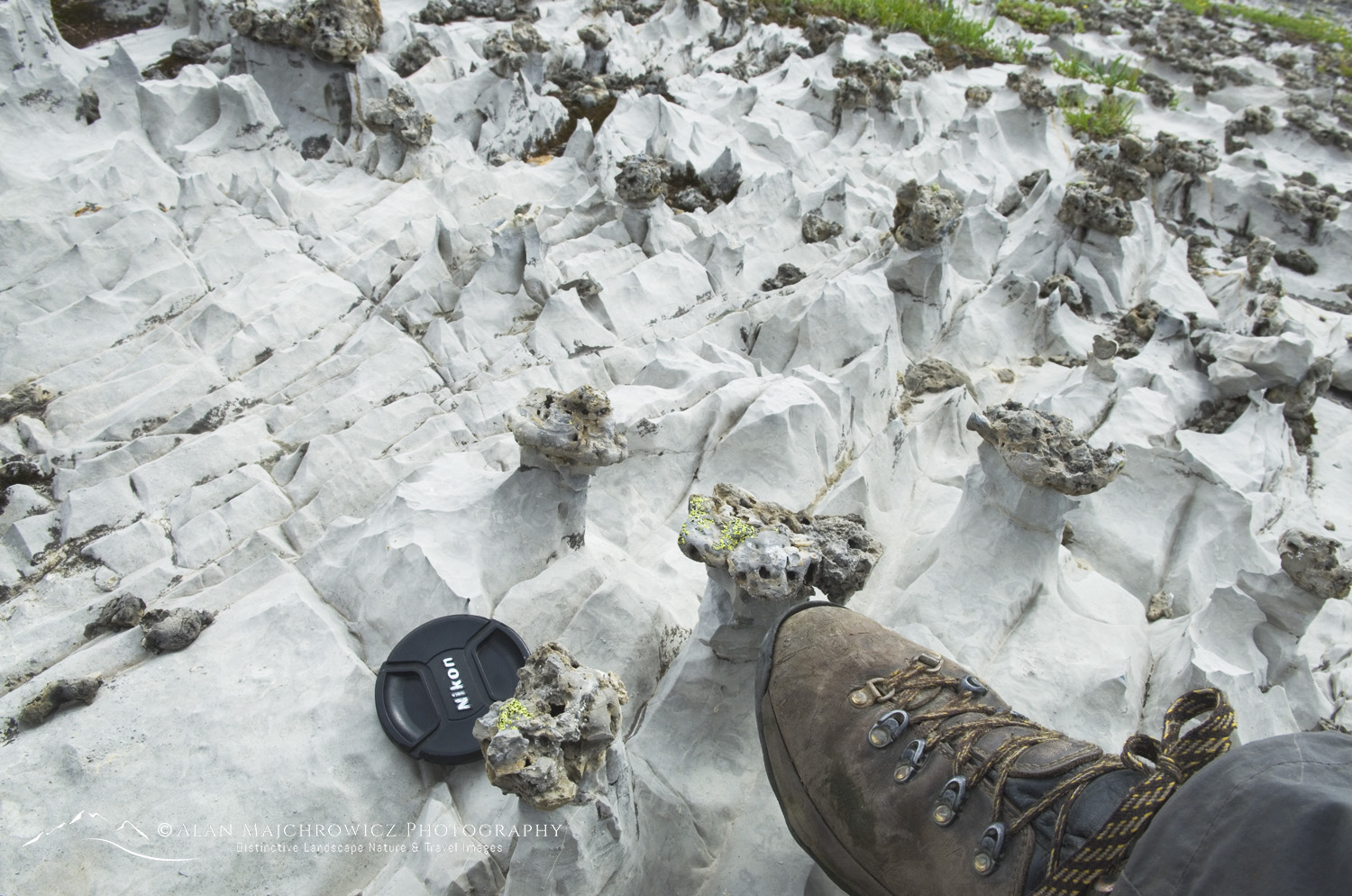
After locating the return trail, memorize it or take a photo before proceeding to the lakes. Now turn and head southwest across an increasingly broken terrain with lots of prickly limestone needles, fissures, and blocks. Fans of The Lord of the Rings will easily associate this section with the Emyn Muil

Sharp karst features in limestone, Height of the Rockies Provincial Park British ColumbiaSharp limestone formations

There are cairns seen sporadically throughout this area, but they’re often far apart and not always reliable. Make a general heading towards the limestone terraces, keeping a sharp eye out for the easiest passages up and through them.

If you are attempting to reach the lakes in one day, the terraces will be the most tiring part of the day. Here, seemingly easy passages through the cliffs will dead-end. Backtracking can be frequent, and when cresting one terrace, there always seems to be another to negotiate. Finally, after topping the last terrace, the terrain becomes easier, and you hike south to a talus pass.

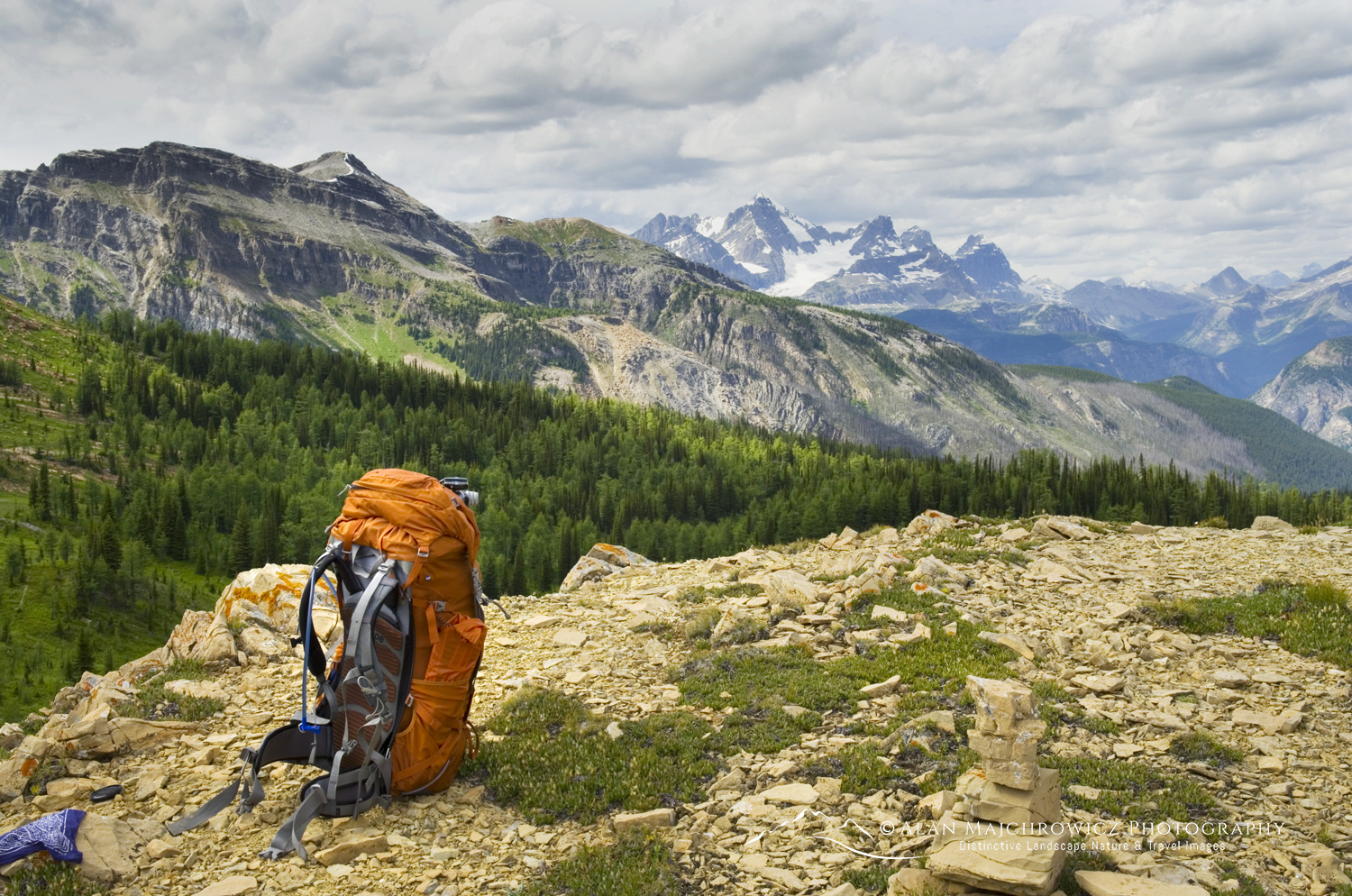
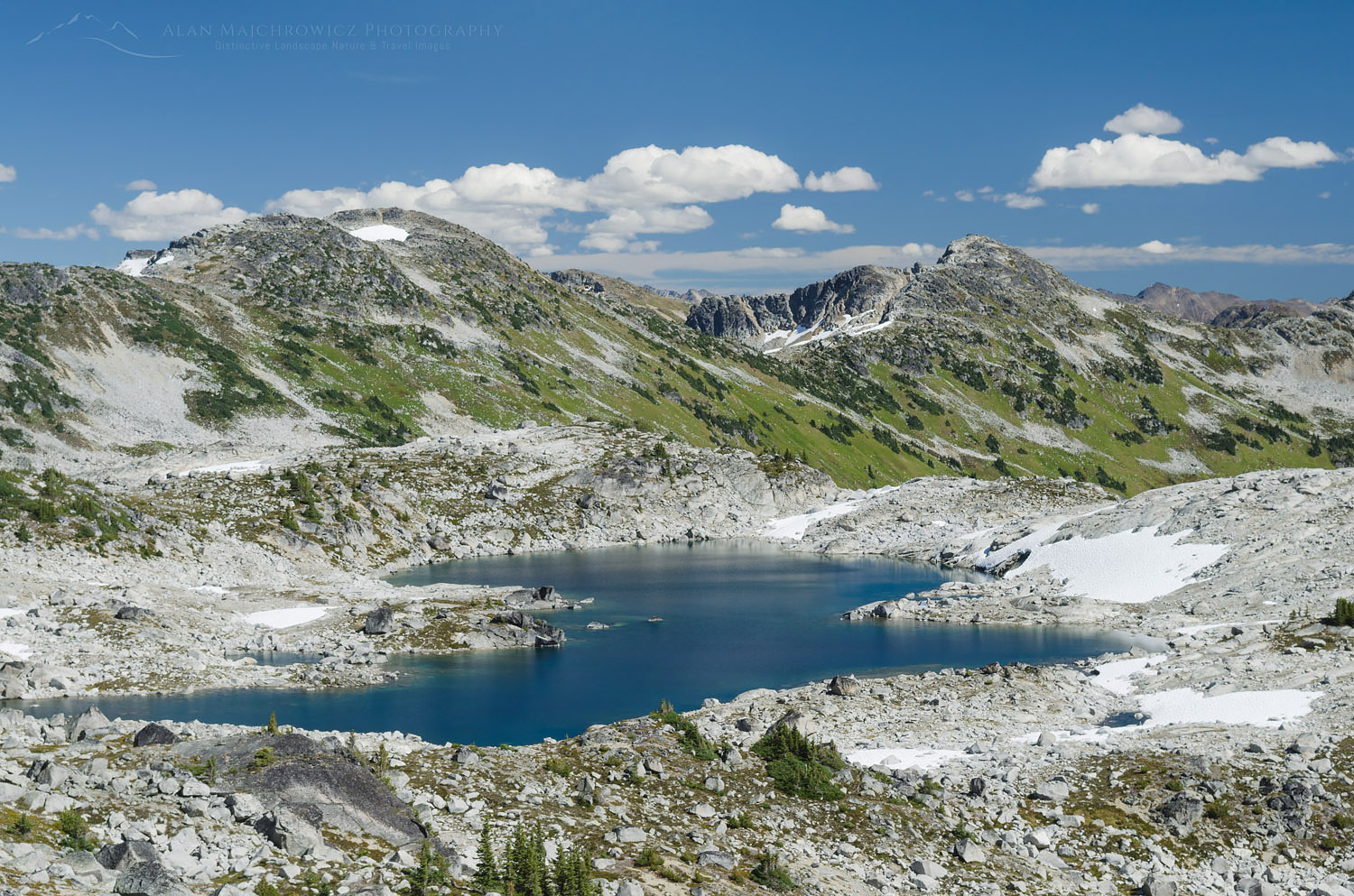
Upon reaching this pass, take in the majestic view you worked so hard to see. Spread out before you is the Limestone Lakes basin. Below are the sparkling lower lakes, and to the right is the turquoise glacial middle lake. Backing it all up are the multiple summits and glaciers of Russell Peak. Truly a breathtaking scene!
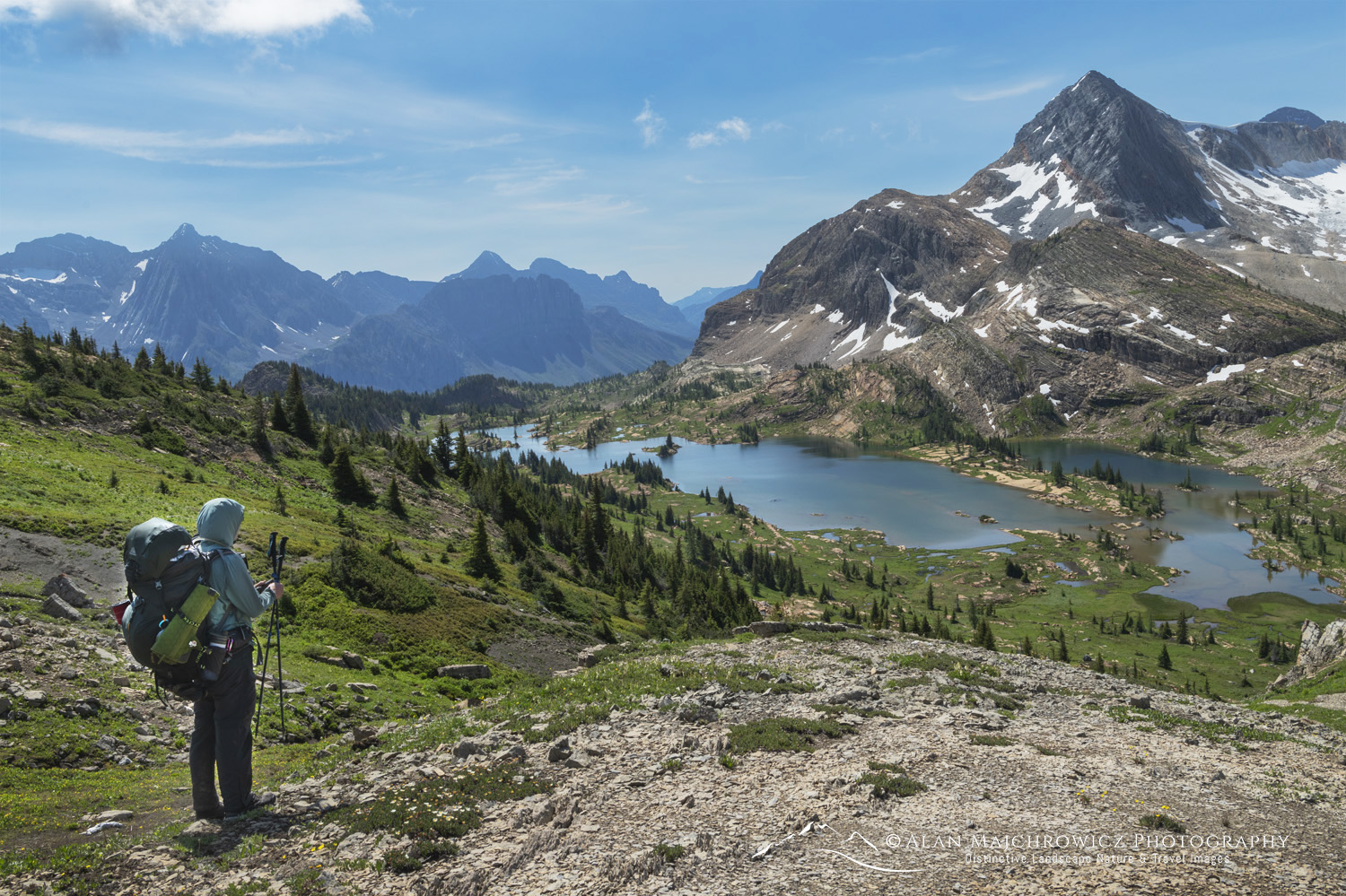
Backpacker overlooking Limestone Lakes Height of the Rockies Provincial Park British ColumbiaFirst view of Limestone Lakes #86390  Purchase

Limestone Lakes Base Camp

Choosing a base camp can be a difficult decision. There are no established camps anywhere in the area. You are pretty much free to camp wherever you like, except of course directly on fragile meadows. My choice was to find a spot high above the lakes. There you can enjoy the broad view directly from your tent. And exploration of all the lakes is within easy reach.

Note that while the lower lakes look very attractive, camping there among the meadowy wetlands will be more buggy. You’ll also need to climb back up to reach the other lakes. On the other hand, there may be very few water sources at camps above the lakes. This is especially true in late summer when snow patches are gone, and meadow creeks are dried up.
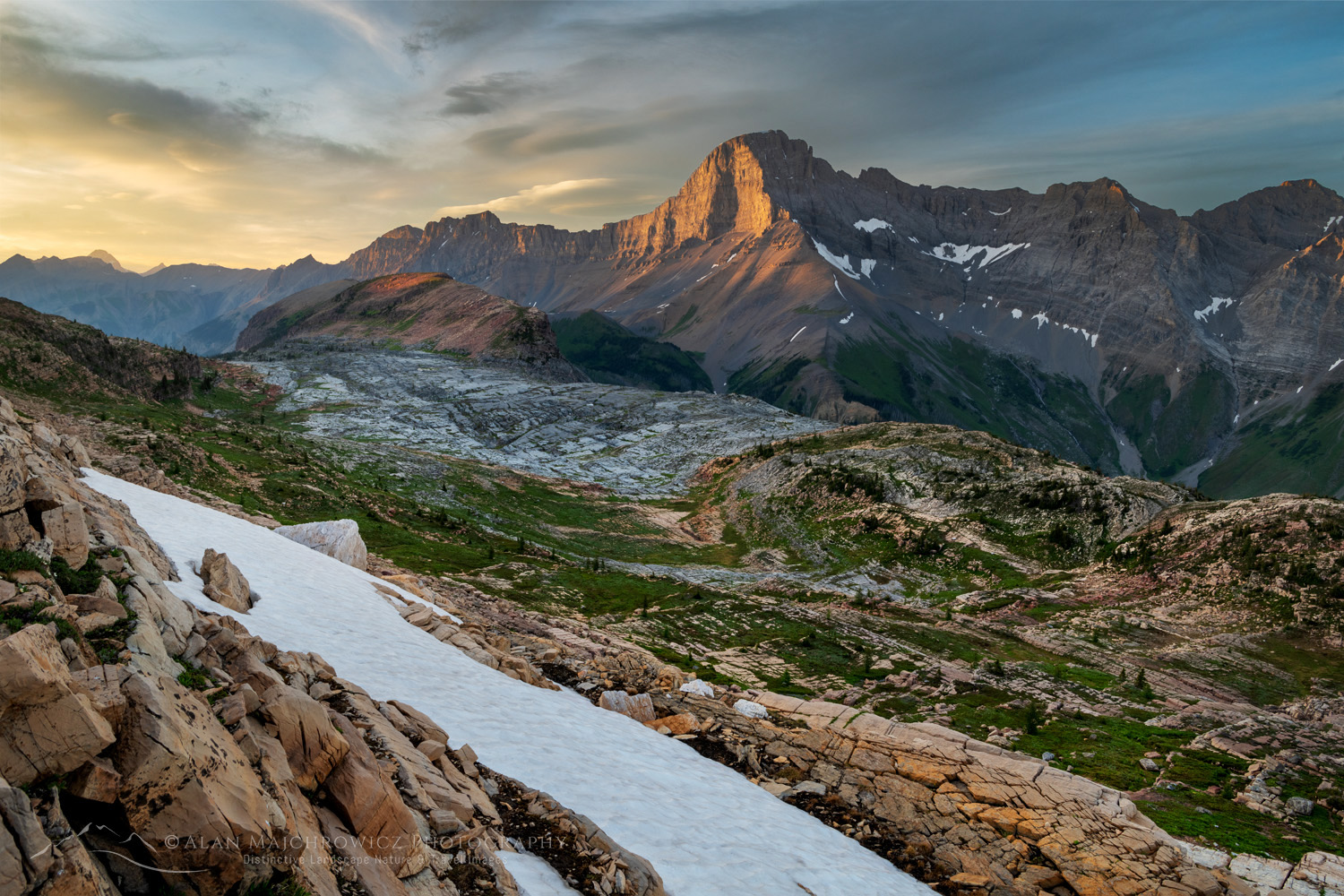
Mount Joffre seen from Limestone Lakes Basin in Height of the Rockies Provincial Park British ColumbiaJoffre Peak from Limestone Lakes #86453 Purchase

Exploring Limestone Lakes

From a higher camp, there are several areas to choose from. Being a photographer, lighting conditions always dictate my decisions. The entire area receives good golden-hour light in both morning and evening. However, the peaks east along the Divide are better in the evening hours.

My first exploration after setting up camp was hiking east and higher from the pass. There are a few more broken ledges to climb before the view opens up to a jaw-dropping view over fascinating karst terrain and the Continental Divide. Before you is a terrain of broken limestone terraces reminiscent of a Roman Coliseum. Looking northeast is the imposing bulk of Joffre Peak, beyond the route and nub you just crossed.
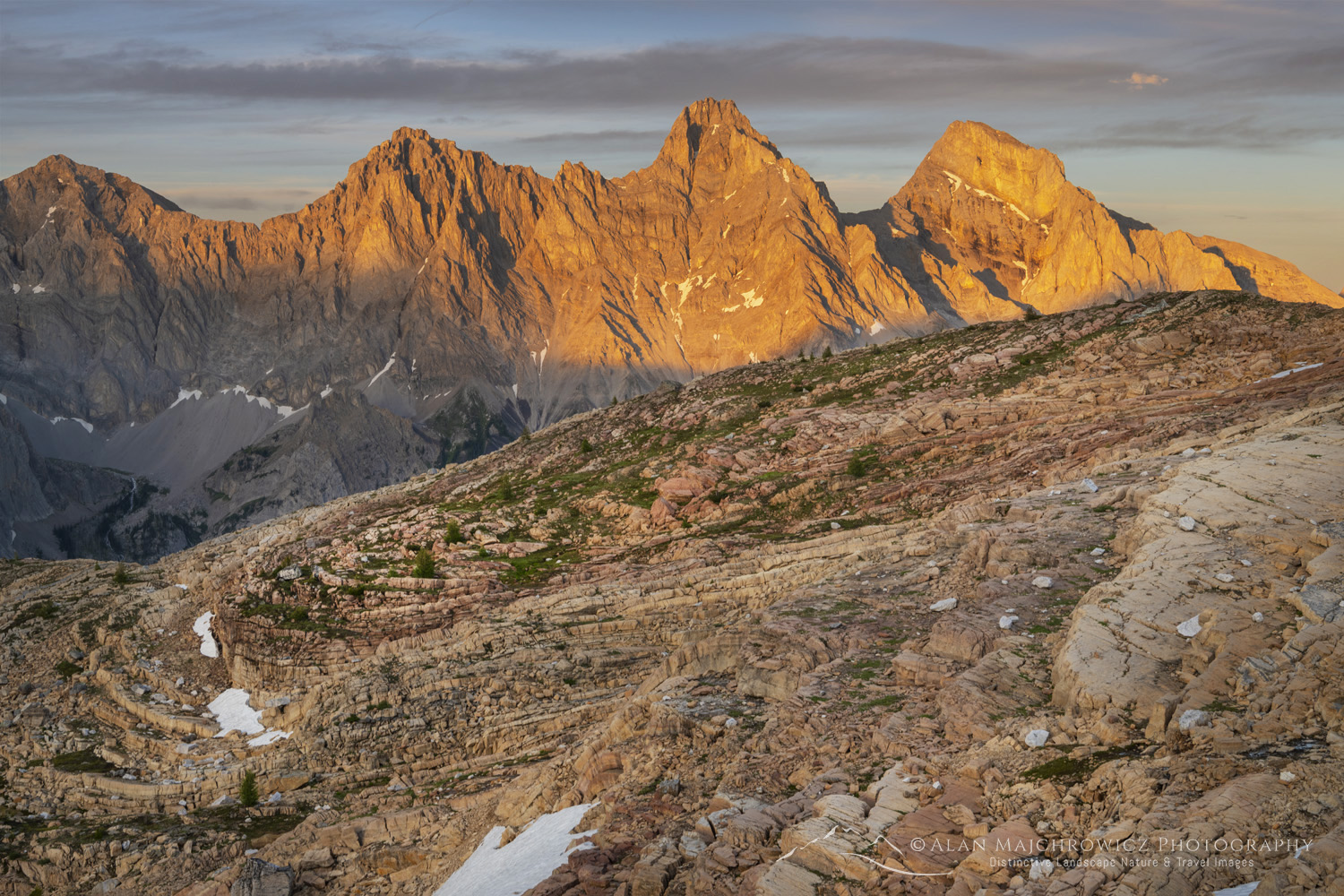
Karst formations in Limestone Lakes Basin Height of the Rockies Provincial Park“Coliseum” limestone ledges and the Continental Divide #86451 Purchase

If you have only one full day at the lakes, I suggest first heading down to the scenic turquoise middle lake, then continuing a little higher to the west lakes. The entire area is wide open, crossing up and down meadowy ledges. One of the joys of exploring here is discovering numerous ponds and small cascading creeks.
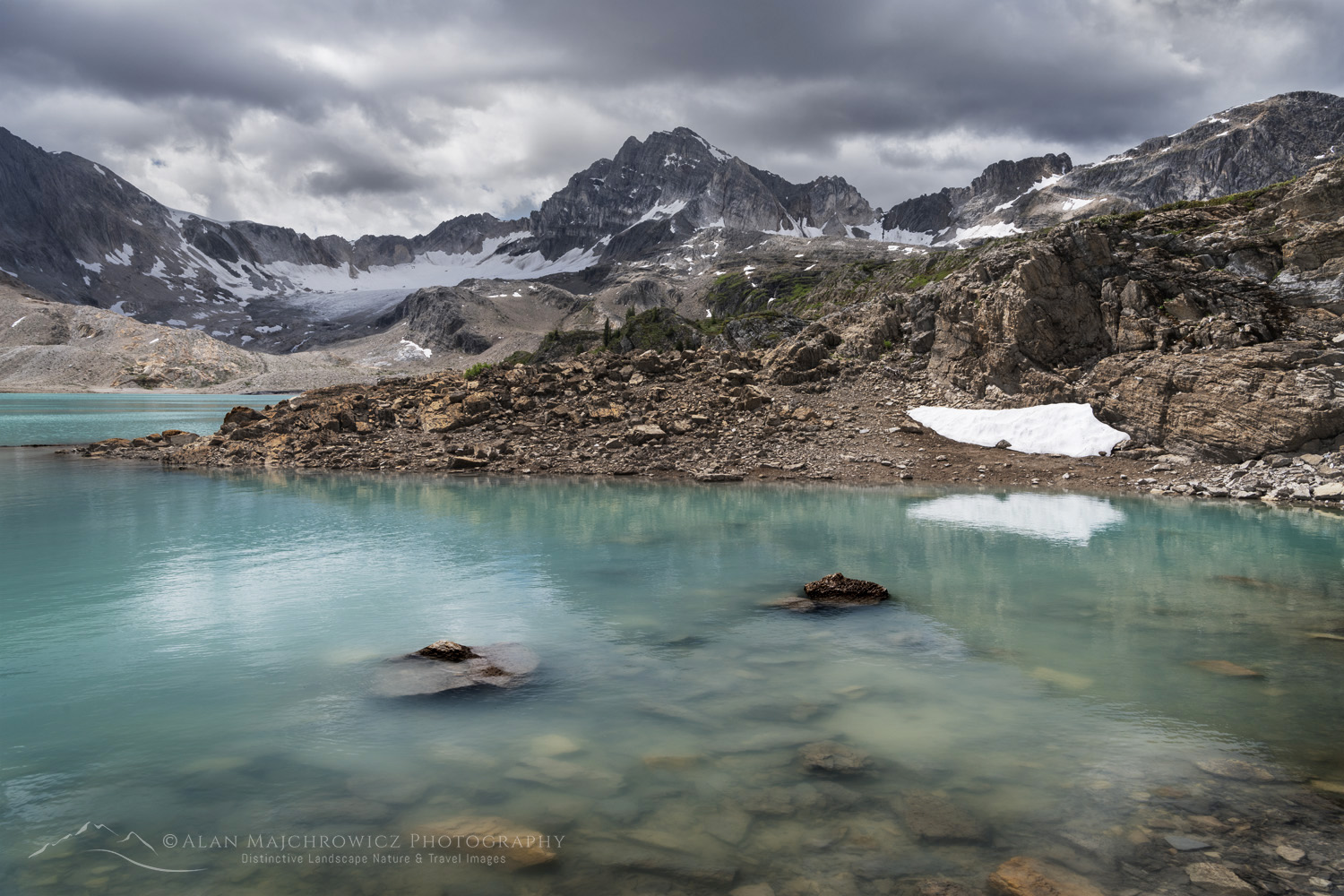
Middle Limestone Lake. Limestone Lakes Height of the Rockies Provincial Park British ColumbiaMiddle Limestone Lake #86503  Purchase

Small lake draining into a sinkhole in Limestone Lakes Basin Height of the Rockies Provincial ParkLake draining into sinkhole #46177 Purchase
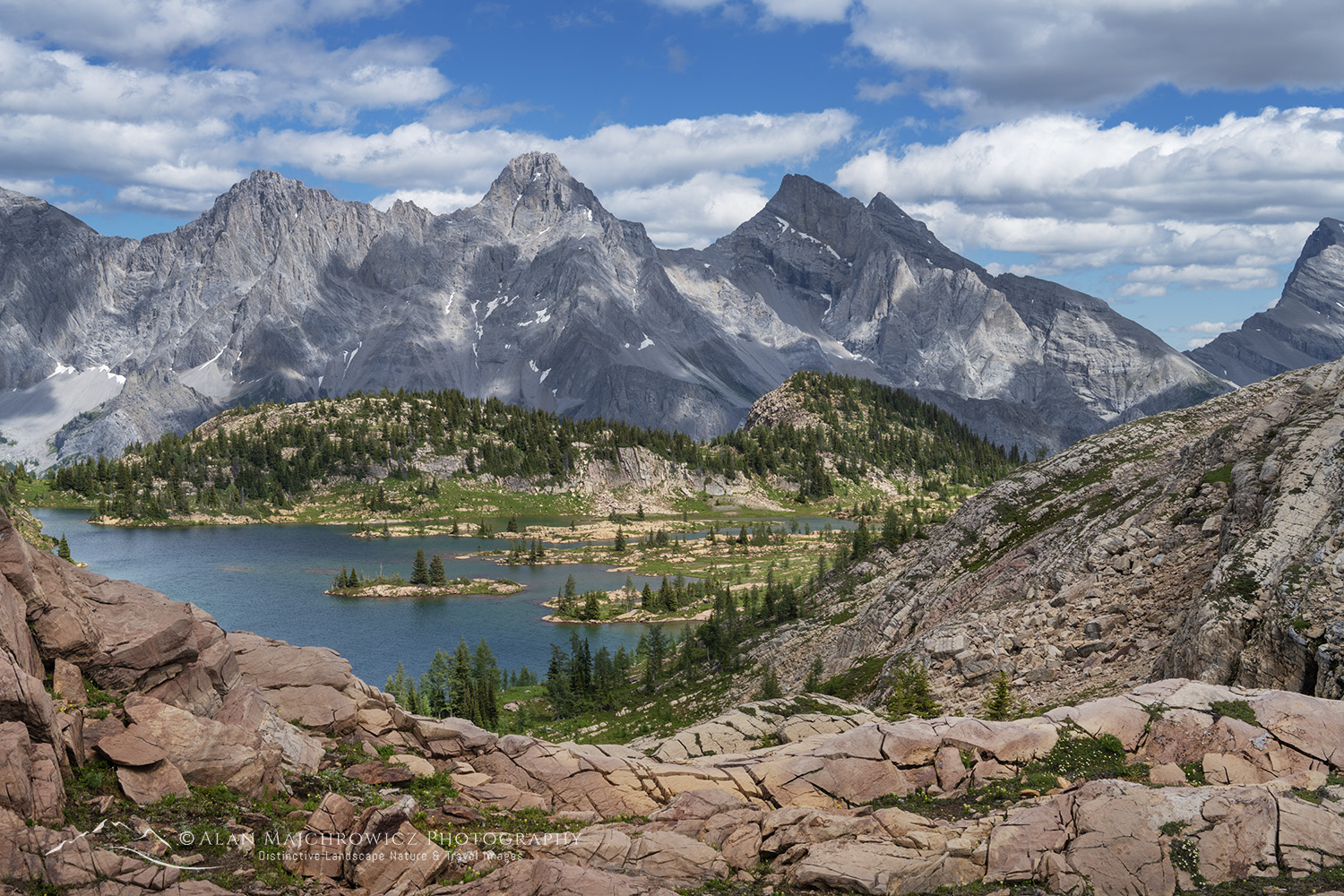
Lower Limestone Lakes. Limestone Lakes Basin. Height of the Rockies Provincial Park British ColumbiaLower Lakes and peaks of the Continental Divide #86545  Purchase

On my first visit, I came across a small lake in this area that was draining into a subterranean cavity. Was there an expansive glittering cave under my feet? Who knows? But on my second visit, I was unable to locate this oddity again.

Hiking east is a wonderful broad and open ridge separating the middle from the lower lakes. This ridge is very obvious from the first high view of the basin. It would also make an excellent base or second-day camp. If I ever go back again, I’ll definitely stay here a night or two! The view with the lower lakes backed by the peaks of the Divide is unforgettable.
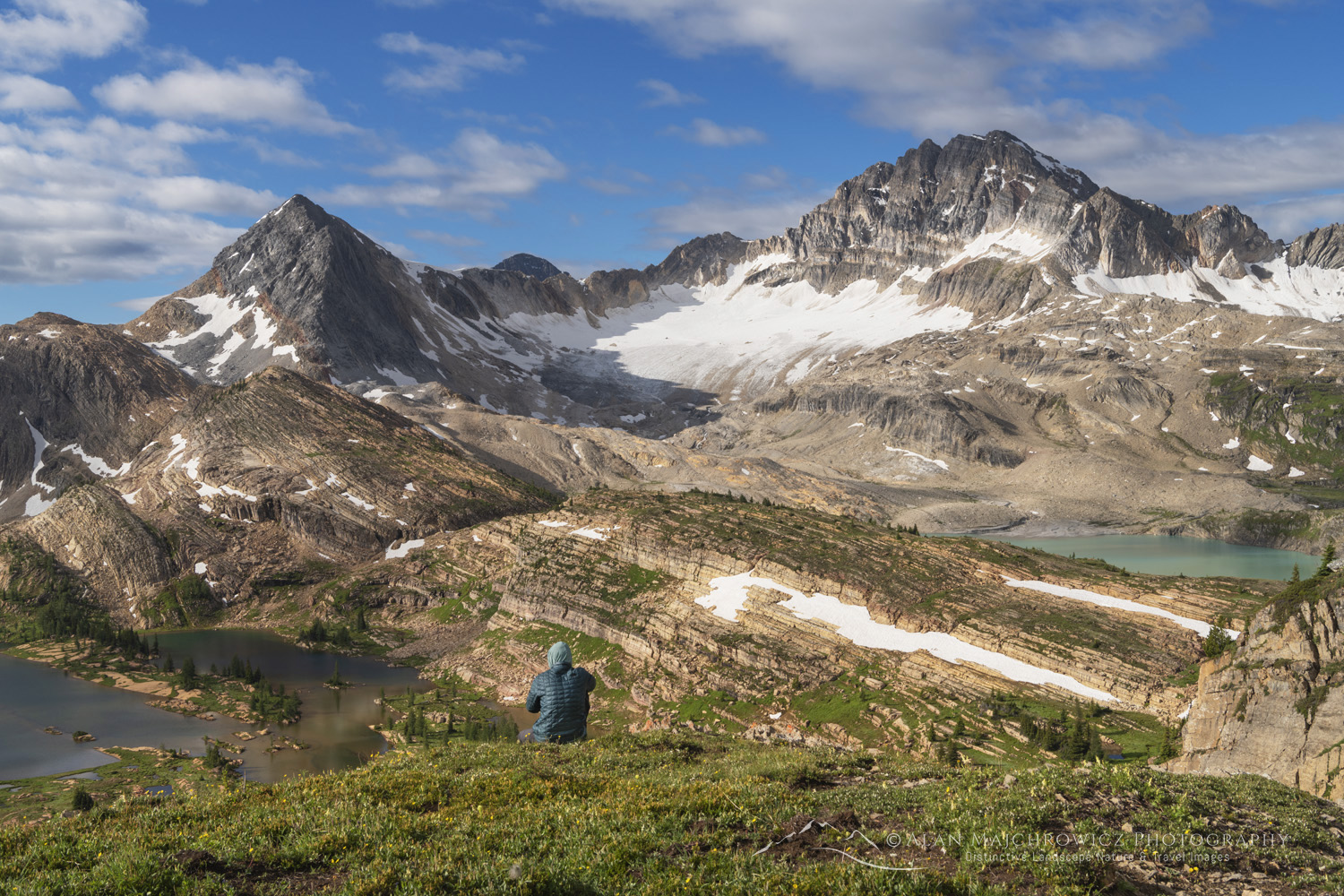
Hiker overlooking Limestone Lakes Basin in Height of the Rockies Provincial Park British ColumbiaTaking in the view of Limestone Lakes #86476  Purchase

The Return Route

After taking in the sights, it’s easy to see why I highly recommend staying at Limestone Lakes for at least two days. It’s such a shame to work so hard to get there and not have enough time to thoroughly enjoy it.

It is also easy to see why it is essential to have good weather throughout the trip. Recrossing all that open terrain with confusing ledges in rain or snow, with poor visibility, would be a nightmare. Not to mention the long, wet slog back down the valley trail.

Getting back to the spot where the alternate trail enters the forest can be frustrating. Even with careful route-finding and a GPS, the trail is elusive. When it is located, the trail still periodically disappears in the first mile or so. Eventually, the trail becomes more obvious and well-trod. However, it is always very rough with many frustrating ups and downs and numerous downed trees to cross.

At times, it may seem that going back the same way you came, over the nub, would have been easier. But then the path enters familiar supalpine forest, and the Joffere Creek trail junction appears.

It’s a bit of a bittersweet moment knowing that nearly all your hard work is nearly over, but the beauty of Limestone Lakes is now a memory.
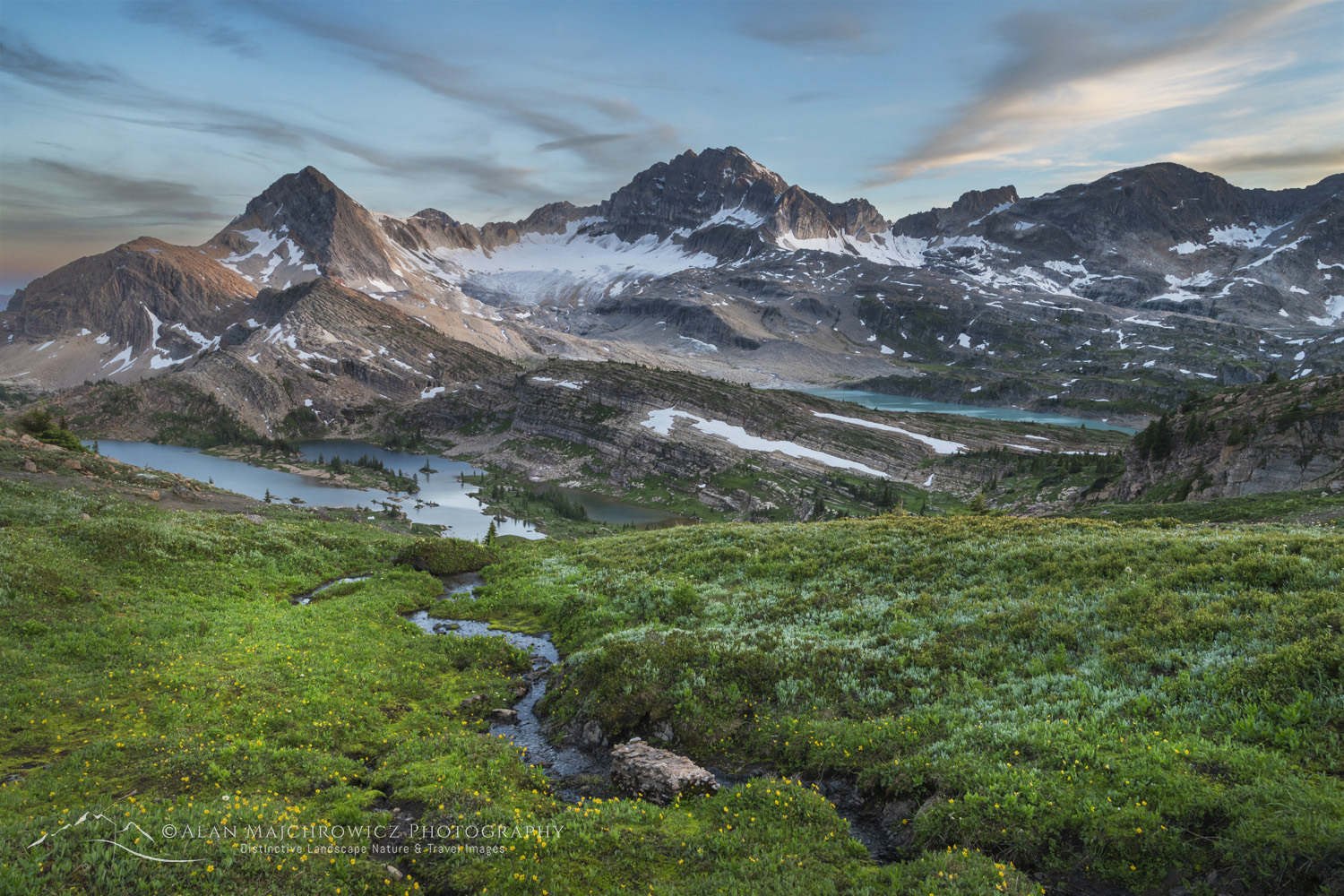
Limestone Lakes Basin. Height of the Rockies Provincial Park British ColumbiaParting view of Limestone Lakes and Russell Peak #86460  Purchase

If You Go to Limestone Lakes Height of the Rockies:

Trip length: 30 miles, round trip
Elevation Gain: 5600′
Permits: None needed as of 2026
Wildlife:
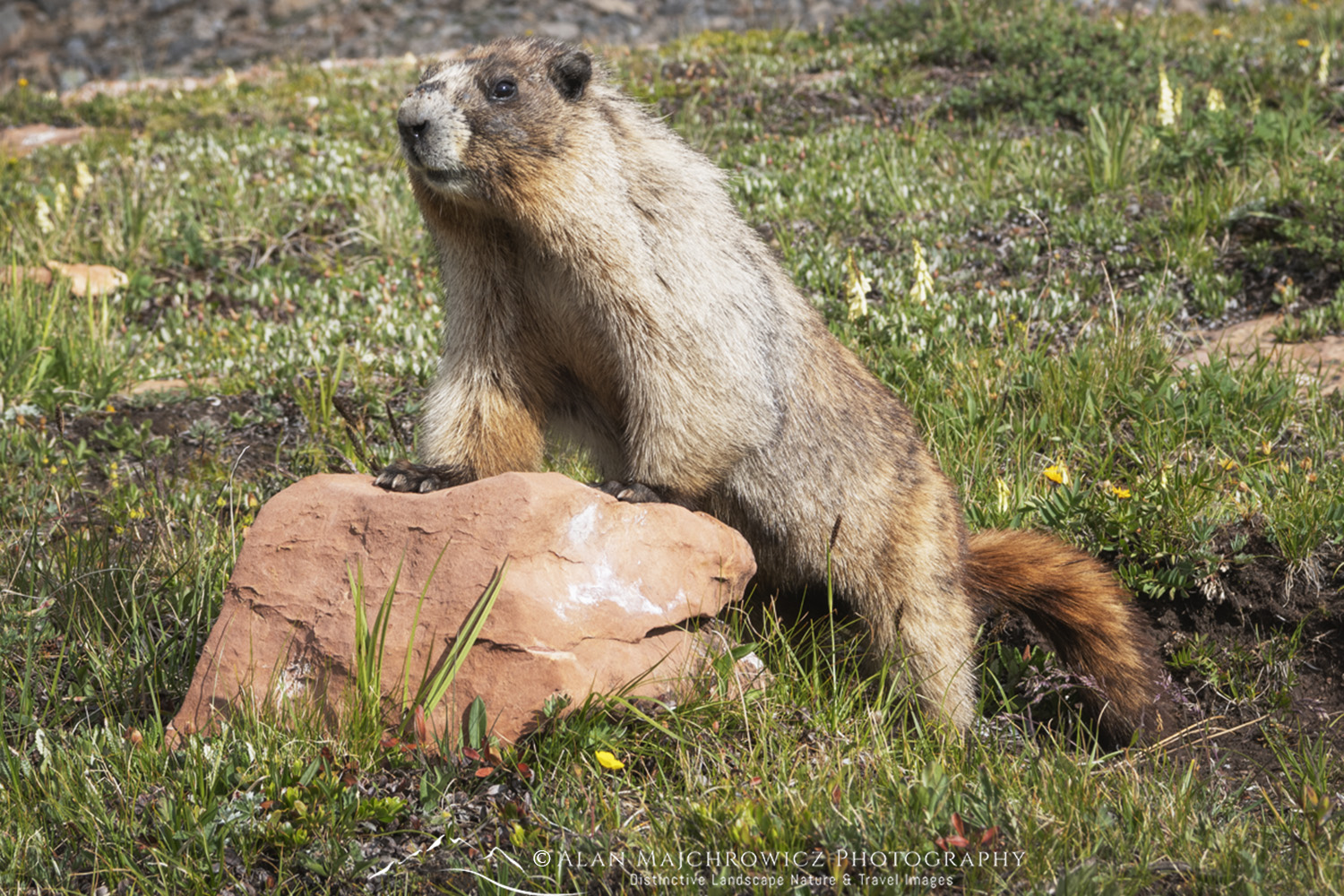
On both of my trips, I saw nothing more than marmots. However, that doesn’t mean bears are absent. The entire length of the Canadian Rockies is grizzly bear country. There are very few trees available to hang food bags in the lakes basin. Bear canisters are advised.

References Height of the Rockies Provincial Park
Mat Gunn’s excellent guidebook: Hikes Around Invermere & the Columbia River Valley.

Read:
Limestone Lakes Height of the Rockies Provincial Park Part 1

For tips on preparing for a backpacking and or photography trip to Limestone Lakes, check out these posts:

Backpacking Photography Gear Tips

Backpacking Photography Tips

Leave No Trace

Please, Please, Please!  Don’t plan a trip to this or any other national park, monument, or wilderness area unless you are prepared to follow Leave No Trace guidelines (LNT). National parks and wilderness areas worldwide are under incredible pressure from the growing number of visitors. So, please do your part to help preserve these precious areas for future generations!

Please visit the Leave No Trace Center for Outdoor Ethics to learn more about LNT’s principles. Your children and grandchildren will thank you!

LEAVE NO TRACE SEVEN PRINCIPLES

1. Plan and Prepare
2. Travel and Camp on Durable Surfaces
3. Dispose of Waste Properly
4. Leave What You Find
5. Minimize Campfire Impacts
6. Respect Wildlife
7. Be Considerate of Other Visitors
© Leave No Trace: www.LNT.org

Learn about how to protect the places we love to photograph
Visit the Nature First Website

Nature First the alliance for responsible nature photography

All photos appearing in this post are available for Commercial Licensing and Fine Art Prints. Click on any image to purchase, or contact me for more info!
Limestone Lakes Height of the Rockies Provincial Park: Part 2
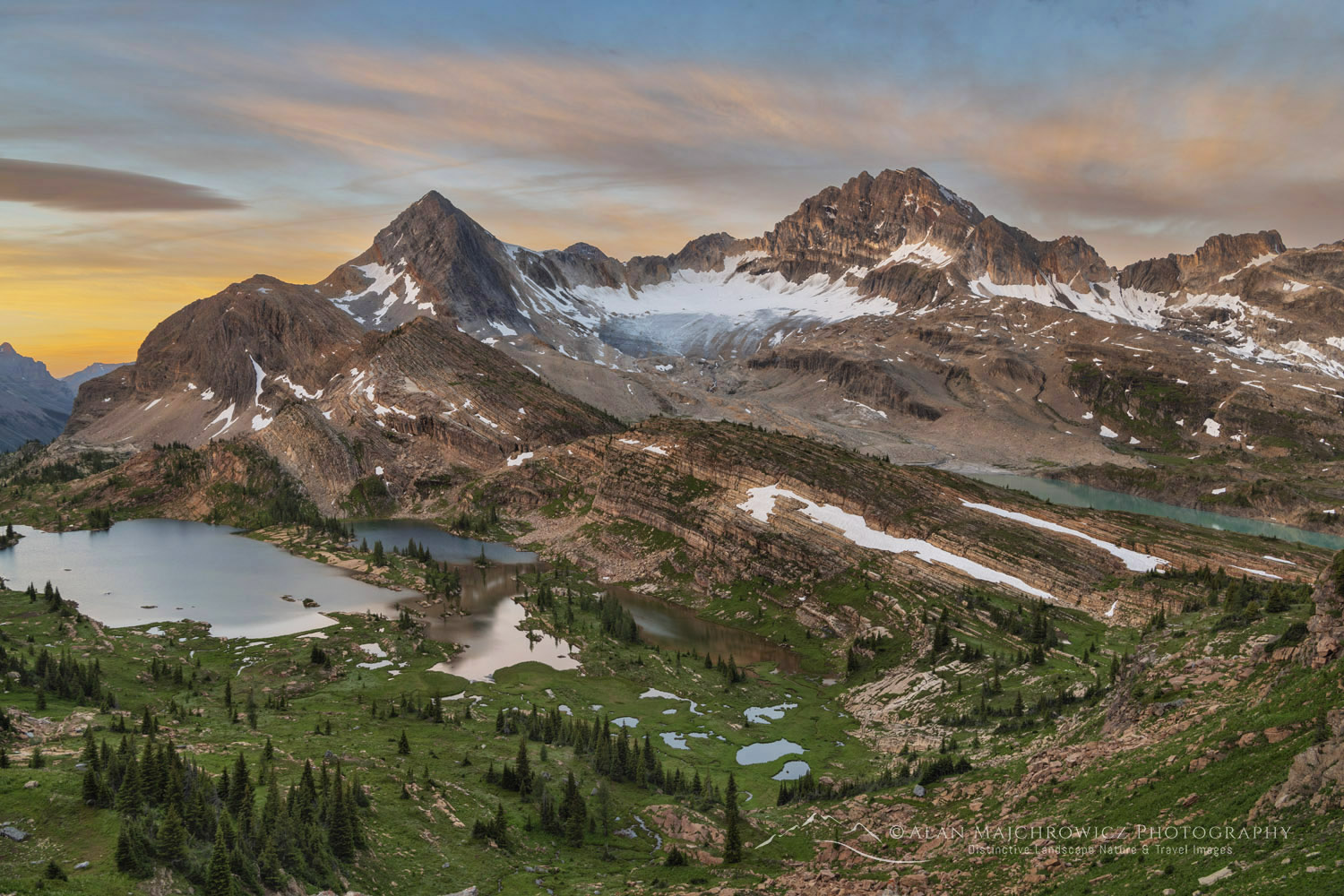
Limestone Lakes basin, Height of the Rockies Provincial Park, British Columbia #86593

Limestone Lakes Height of the Rockies Provincial Park Part 1

Evening light over Russel Peak and Limestone Lakes in Height of the Rockies Provincial Park British Columbia Limestone LakesRussell Peak and Limestone Lakes  #86593  Purchase

Limestone Lakes Height of the Rockies Provincial Park

Limestone Lakes, in Height of the Rockies Provincial Park, is a dream destination for backpackers and photographers who really want to get away from it all. In today’s era of advance reservations, lottery-style permits, and crowds, this location offers a taste of wilderness freedoms rarely seen anymore. Here, in the middle of the Canadian Rockies, you can experience a level of solitude amid grand landscapes seldom found outside the most remote locations on Earth.

Height of the Rockies Provincial Park is a small, little-known park in the Canadian Rockies. It is located on the west side of the continental divide, just southwest of Mount Assiniboine. There are a couple of reasons for the park being so little-known. The first is its remote location. The main access to the park is an unpaved road about 40 miles in length. Although the road is generally in good shape for ordinary vehicles, it is a very long and dusty drive. Another reason is the park’s relatively few maintained trails. These trails are mostly user-maintained and are often little more than routes.  Reaching the fabulous alpine areas requires lots of work and determination. Limestone Lakes is, perhaps, the main destination in Height of the Rockies Provincial Park, which is accessed by one of those trails.

Evening light over Russel Peak and Limestone Lakes in Height of the Rockies Provincial Park British Columbia Limestone LakesLower Limestone Lakes and Russell Peak #86447 Purchase

Limestone Lakes Difficulty Level

*Before I go any further, I must impress the fact that a trip to Limestone Lakes is definitely not for novices to backpacking or wilderness travel.  However, those who are accustomed to cross-country wilderness travel and mountaineering will find the trip relatively easy. From the first step at the trailhead, the entire trip is an arduous undertaking. About half of the distance is on a long, steep, brushy, and poorly maintained trail. In some long sections, it is merely a boot-beaten route. The second half is an unmarked cross-country route across difficult alpine terrain.

A reasonable trip to Limestone Lakes would require at least three days. Given that, to truly explore and enjoy this magnificent location would require four to six days.

To this date, I have made two wonderfully memorable trips to Limestone Lakes. The first trip was solo, and the second was to guide a fellow wilderness lover. Through both trips, I have learned a few lessons that I can pass on to others wishing to visit this area.

Height of the Rockies Provincial Park View north to the Royal Group from Sylvan Pass

When to Visit Limestone Lakes

Early July through mid-September are optimum times to visit Limestone Lakes. By early July, the alpine areas are generally snow-free, but creek crossings can still be challenging. September will see the end of flying insects, but there is an increasing risk of early-season snow.

I won’t get into specific details regarding elevations, distances, or GPS coordinates. I don’t use a GPS or other wilderness travel apps, although most will find tham handy. I’ve always relied on plain paper maps and common sense wilderness travel skills, acquired over many years of hiking and backpacking. However, readers will get a good general overview of what to expect.

For more details, please refer to the Height of the Rockies Provincial Park website and Mat Gunn’s excellent guidebook: Hikes Around Invermere & the Columbia River Valley.

Hoary Marmot (Marmota caligata) Height of the Rockies Provincial Park British ColumbiaA local resident of Limestone Lakes #86491 

Pro Tip:  Do not attempt this trip in poor weather! During my most recent trip, it rained for the first two days, and the trail to Sylvan Pass was a nightmare. The hip-high brush was dripping wet, and within minutes, we were soaked to the skin. After miles of this misery, we arrived at a campsite below Sylvan Pass, nearly hypothermic.

In addition, by the time you reach the lakes basin, you are a long way from your vehicle in a vast trail-less alpine arena. Limestone Lakes is not an enviable place to be stuck in case of poor weather with limited visibility! Plan very carefully and be prepared! And don’t forget that in case of bad weather there is nor shame in bailing!

View south from Sylvan Pass, Height of the Rockies Provincial Park British Columbia CanadaLooking south from Sylvan Pass

Joffre Creek Trail

The trailhead is located at the end of the long drive on the Palliser River Road. Here is where the fun starts. The trailhead kiosk sports an enticing photo of the beautiful Limestone Lakes Basin. It also states the trail itself begins a short way up the road on the left, amidst an old burn. It’s very easy to miss this poorly marked spot. And, on my second visit, we couldn’t find it and opted to continue where the trail started on my previous trip. This then entailed a bit of bushwhacking and route-finding.

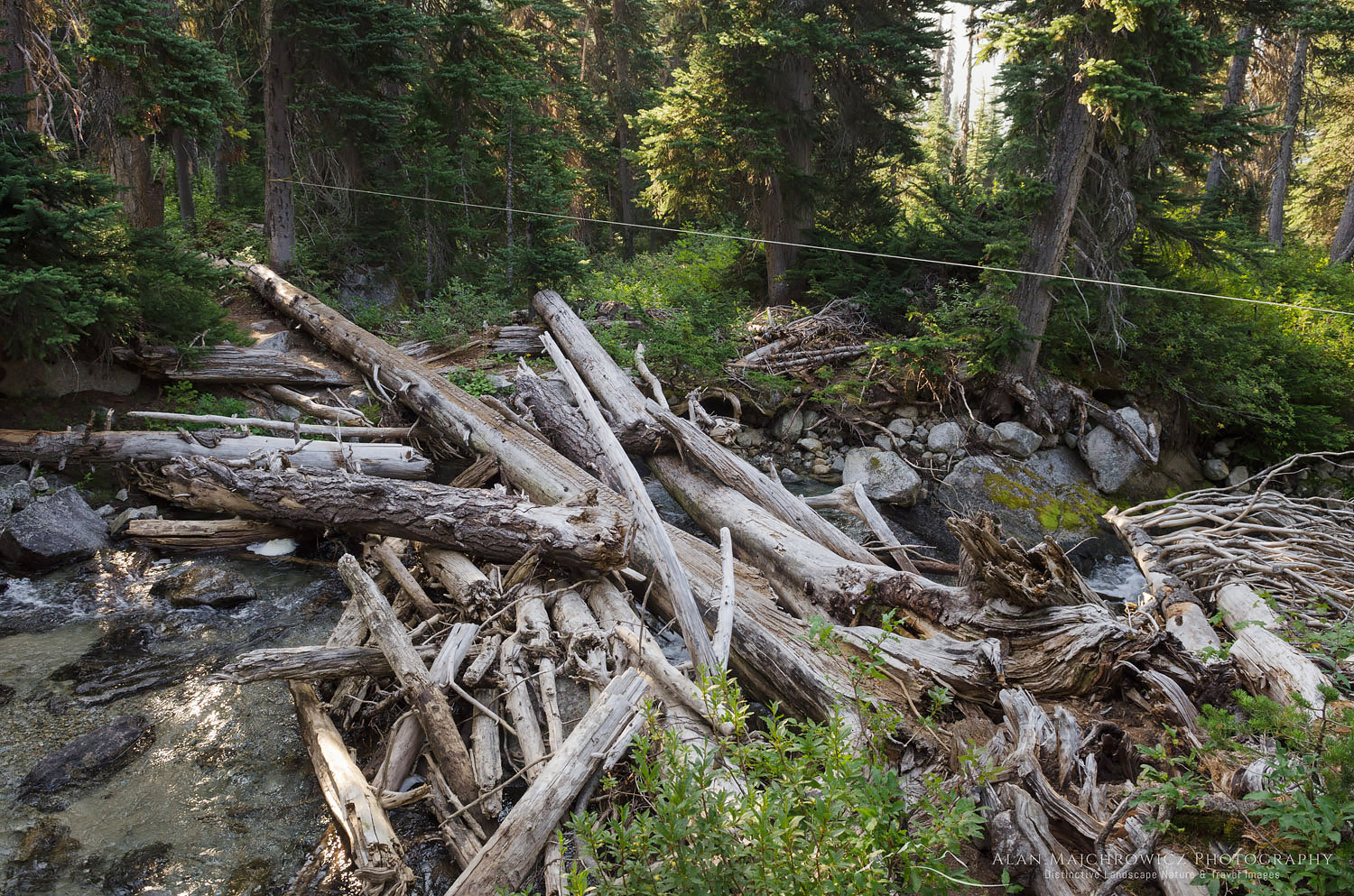
Whether you find the true trail or not, your second obstacle, and possibly a deal-breaker for some, is crossing Joffre Creek. There once was a sturdy bridge crossing the creek. But nature has a way of obliterating man’s designs. Where there once was a pretty creek running through a dense forest, there now is a wide expanse of downed trees and channels choked with rocks and boulders. Needless to say, there is no longer a bridge.  Unless a log jam is found, travellers will need to ford a swift and often deep creek over hidden slippery rocks.

Once on the other side of Joffre Creek, you’ll need to locate the beginning of the true trail. There may be cairns marking it, but if you cross up or downstream, the trail can be difficult to find. It is imperative to travel southeast near the creek to locate it. The start of the Palliser River Trail is also here, so if you start hiking a trail in a northerly direction, you’re on the wrong one.

After a short level stretch through the forest, the trail begins climbing up to the pass in earnest. For the next seven miles, it continues relentlessly up to Sylvan Pass. Along the way, several long, very steep sections are encountered, another major creek crossing, long, marshy boot-soaking stretches, and lots of thick brush where the trail can’t even be seen.

Since this trail receives only a minimum of maintenance, hikers will also encounter plenty of downed trees and other obstacles to negotiate.

It is also important to note that the only suitable campsite before Sylvan Pass is at about the halfway mark. If you get a late start, this would be the place to stop. It is right on the trail just before a long marshy stretch. If you decide to base-camp here and day-hike to Limestone Lakes, you’re still in for a long, arduous day, with little opportunity to enjoy the lakes basin.

Joffre Peak andSylvan Pass, Height of the Rockies Provincial Park, British Columbia, CanadaJoffre Peak and Sylvan Pass, bottom center

Sylvan Pass and Alternate Route

After about 6 miles of hiking, hikers will reach a trail junction where an important decision must be made. At this junction, you are just entering the subalpine zone, with trees beginning to thin out. Here, you can either continue another mile or so on the trail to Sylvan Pass, or take the right-hand junction to an alternate route to Limestone Lakes.

The first option to Sylvan Pass is my personal recommendation. It involves more elevation gain and route-finding, but it is all above timberline and definitely more scenic. It also offers an excellent view of the route across the karst plateau, which you must cross to reach the lakes. On the downside, after climbing the nub above the pass, hikers will need to descend considerably and negotiate some moderate ledges and cliffs to enter the extensive karst basin.

On the other hand, the alternate route at the junction is a bit more direct, but it involves lots of ups and downs. In addition, it is a very rough trail, nearly always in the forest, and, in addition, affords no views. I recommend taking the Sylvan Pass route on the way in and the alternate route on the way out.

Continuing along the trail to Sylvan Pass, the terrain finally opens up into a pleasant sub-alpine meadow. There are very few established sites to pitch a tent, therefore choose a spot in the trees away from the fragile meadows. From here, Sylvan Pass is visible, about one-half mile further up from the meadows.

 Height of the Rockies Provincial Park, British Columbia, Canada8300′ nub seen from Sylvan Pass

Sylvan Pass to the Karst Plateau

Upon reaching Sylvan Pass, you are rewarded with a beautiful vista of rugged mountains, glaciers, and valleys. From here, your route is all cross-country route-finding, except for a few, although possibly misleading cairns.

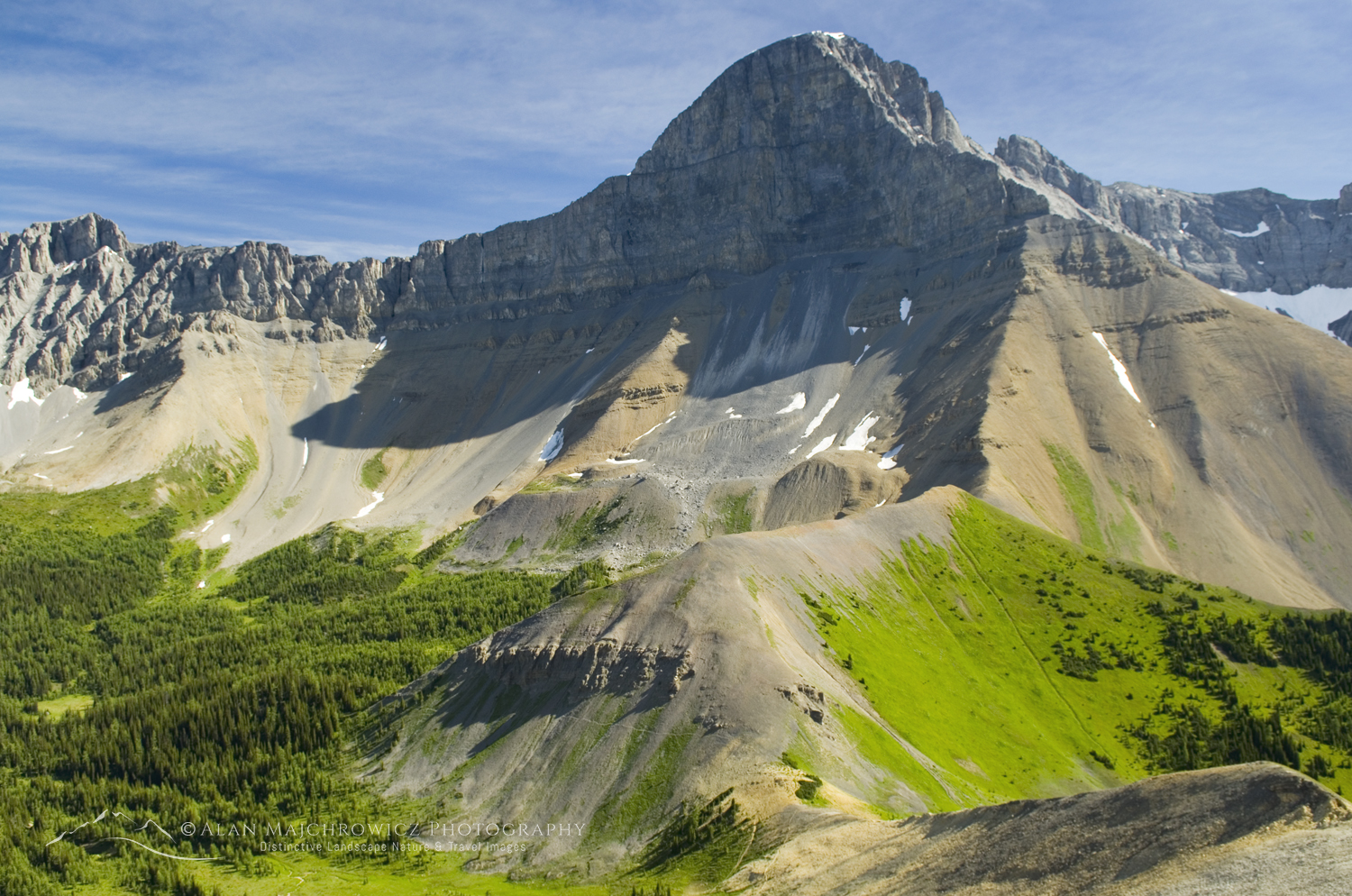
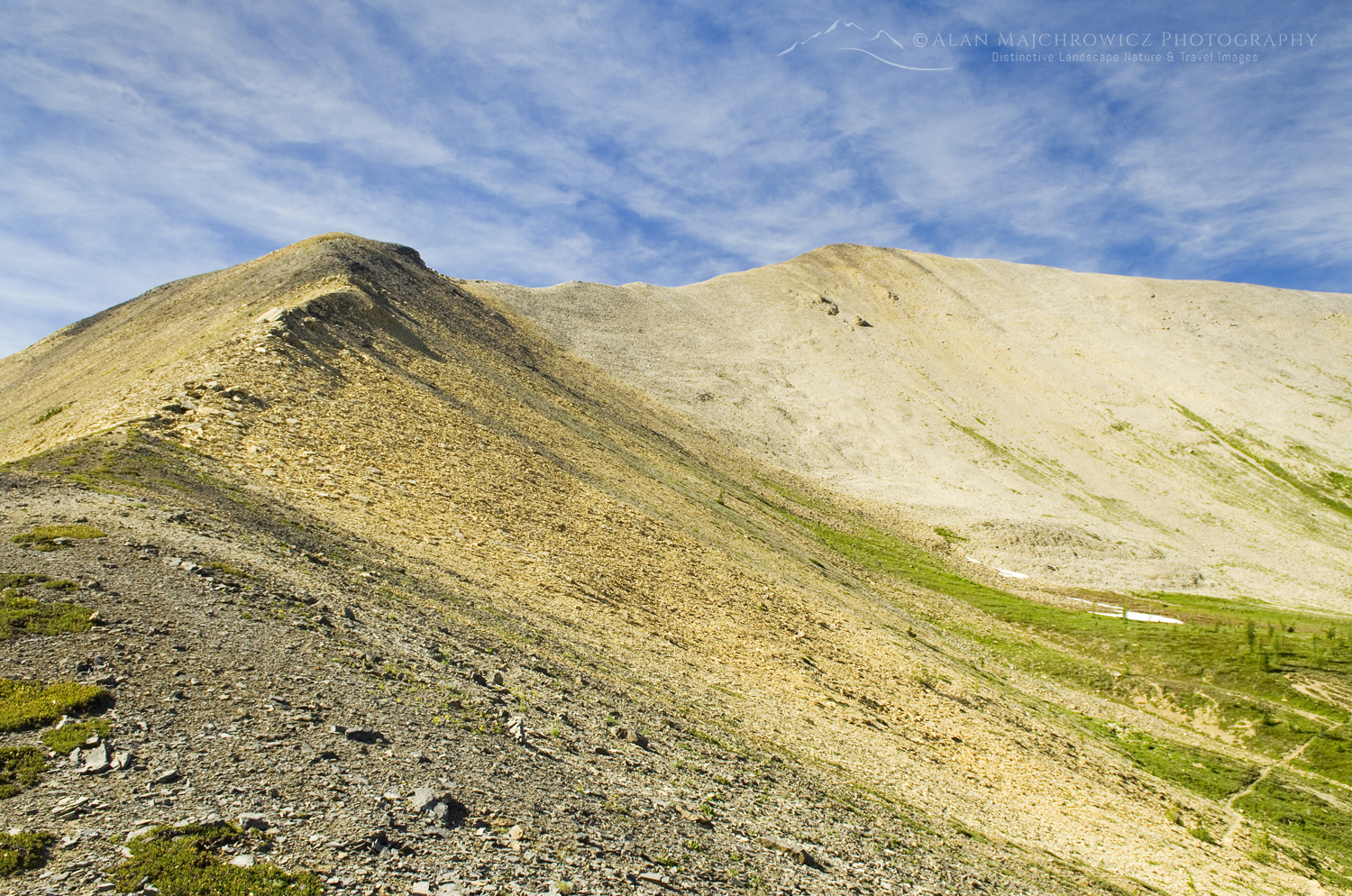
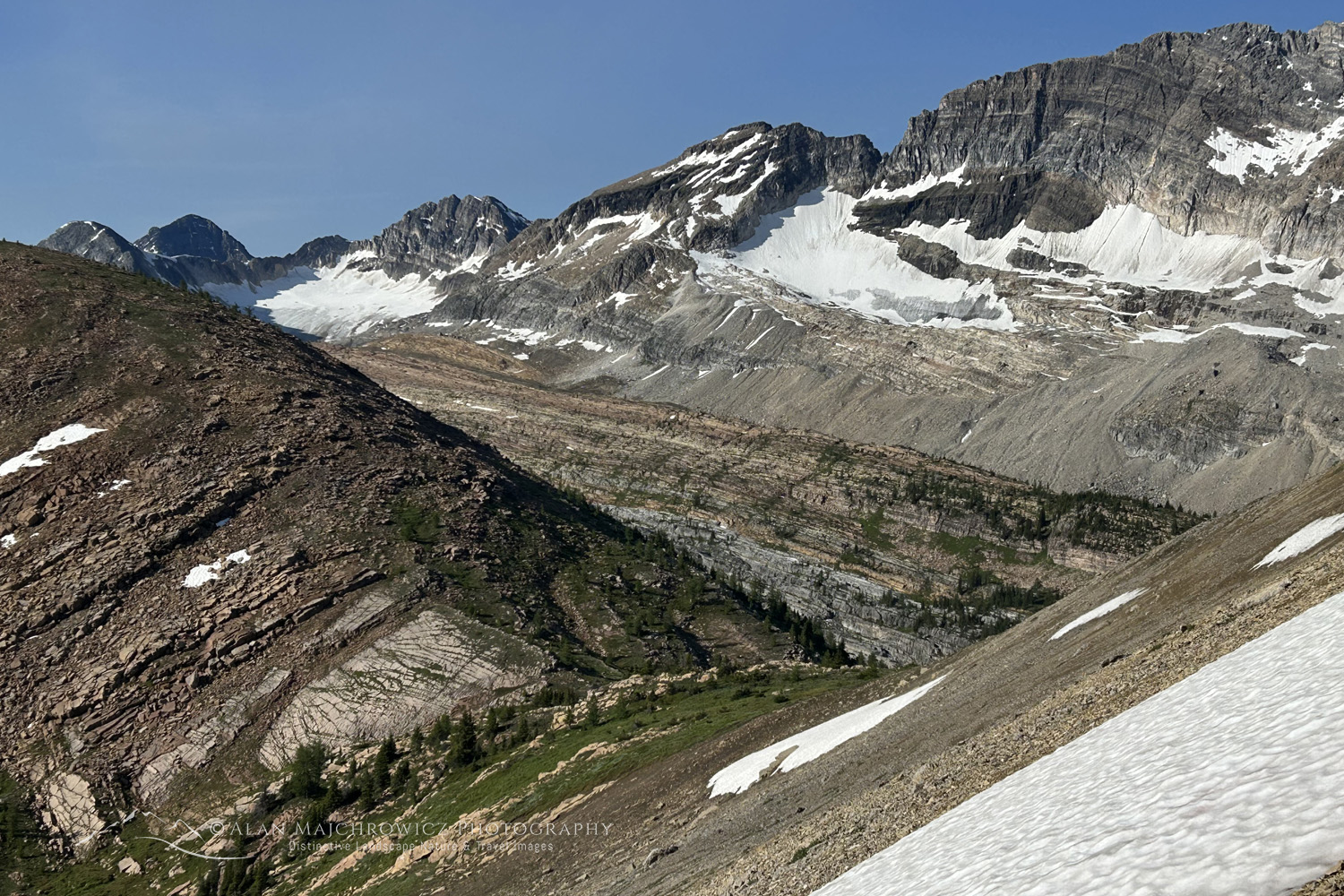
After a brief rest at the pass, hike west up steep, loose talus to the summit of the 8300′ nub. Catch your breath and take in your first views to the southwest of Russell Peak and Limestone Lakes Basin. From here, you have approximately five miles of pure alpine wilderness to negotiate.

Continue to the lakes in:
Limestone Lakes Height of the Rockies Provincial Park Part 2
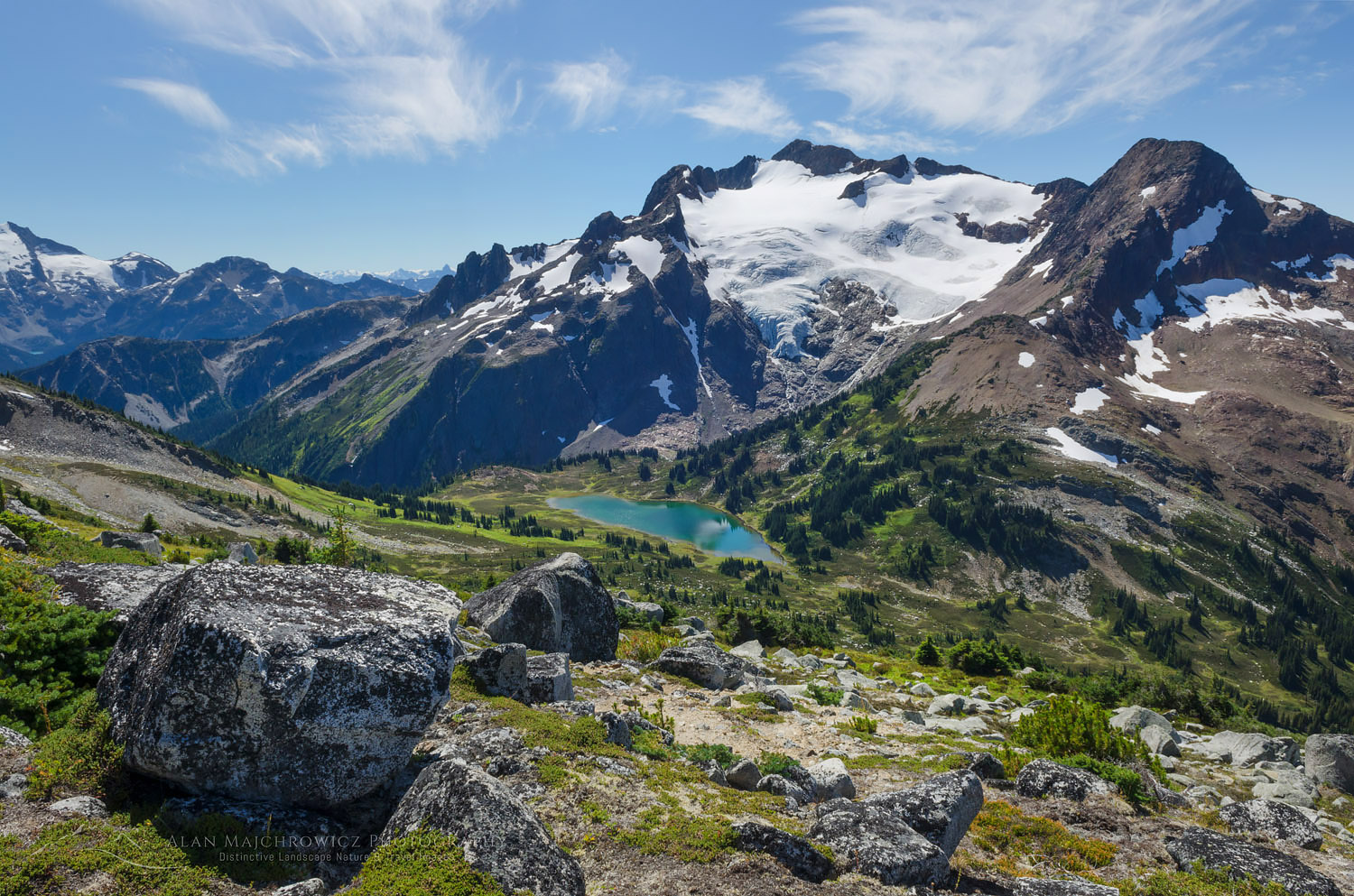
 Height of the Rockies Provincial Park, British Columbia, Canada Limestone LakesFirst view of Russell Peak (far left in distance) from the nub

Limestone Lakes Basic Info:

Trip length: 30 miles, round trip
Elevation Gain: 5600′
Permits: None needed as of 2026
Wildlife:
On both of my trips, I saw nothing more than marmots. Although this may be true, it doesn’t mean bears are absent. The entire length of the Canadian Rockies is grizzly bear country. There are very few trees available to hang food bags in the lakes basin. Bear canisters are advised.

References Height of the Rockies Provincial Park
Mat Gunn’s excellent guidebook: Hikes Around Invermere & the Columbia River Valley.

For tips on preparing for a backpacking and or photography trip to Limestone Lakes, check out these posts:

Backpacking Photography Gear Tips

Backpacking Photography Tips

Leave No Trace

Please, Please, Please!  Don’t plan a trip to this or any other national park, monument, or wilderness area unless you are prepared to follow Leave No Trace guidelines (LNT). National parks and wilderness areas worldwide are under incredible pressure from the growing number of visitors. So, please do your part to help preserve these precious areas for future generations!

Please visit the Leave No Trace Center for Outdoor Ethics to learn more about LNT’s principles. Your children and grandchildren will thank you!

LEAVE NO TRACE SEVEN PRINCIPLES

1. Plan and Prepare
2. Travel and Camp on Durable Surfaces
3. Dispose of Waste Properly
4. Leave What You Find
5. Minimize Campfire Impacts
6. Respect Wildlife
7. Be Considerate of Other Visitors
© Leave No Trace: www.LNT.org

Learn about how to protect the places we love to photograph
Visit the Nature First Website
Nature First the alliance for responsible nature photography

All photos appearing in this post are available for Commercial Licensing and Fine Art Prints. Click on any image to purchase, or contact me for more info!

Limestone Lakes Height of the Rockies Provincial Park: Part 1

Russell Peak and Limestone Lakes Basin, Height-of-the-Rockies Provincial Park, British Columbia, Canada #46109

Summer Photography Adventures 2025

Summer photography adventures are just around the corner, and this summer’s itinerary includes many exciting locations. The general plan is to begin in late June and return somewhere in the beginning of September. It’s an ambitious schedule, and if all goes well, I’ll be returning with many new and spectacular images. However, as always, unforeseen circumstances and weather may alter some planned destinations.

Russell Peak and Limestone Lakes Basin, Height-of-the-Rockies Provincial Park, British Columbia, Canada #46109 Summer Photography Adventures 2025Limestone Lakes Basin. British Columbia  #46109

After a few short warm-up trips in the North Cascades, I will travel to British Columbia, Alberta, Yukon, the Northwest Territories, and Alaska. Many of these locations will involve multi-day backpacking to outstanding and remote locations. And, if all goes as planned, it will even include a short dip in the Arctic Ocean!

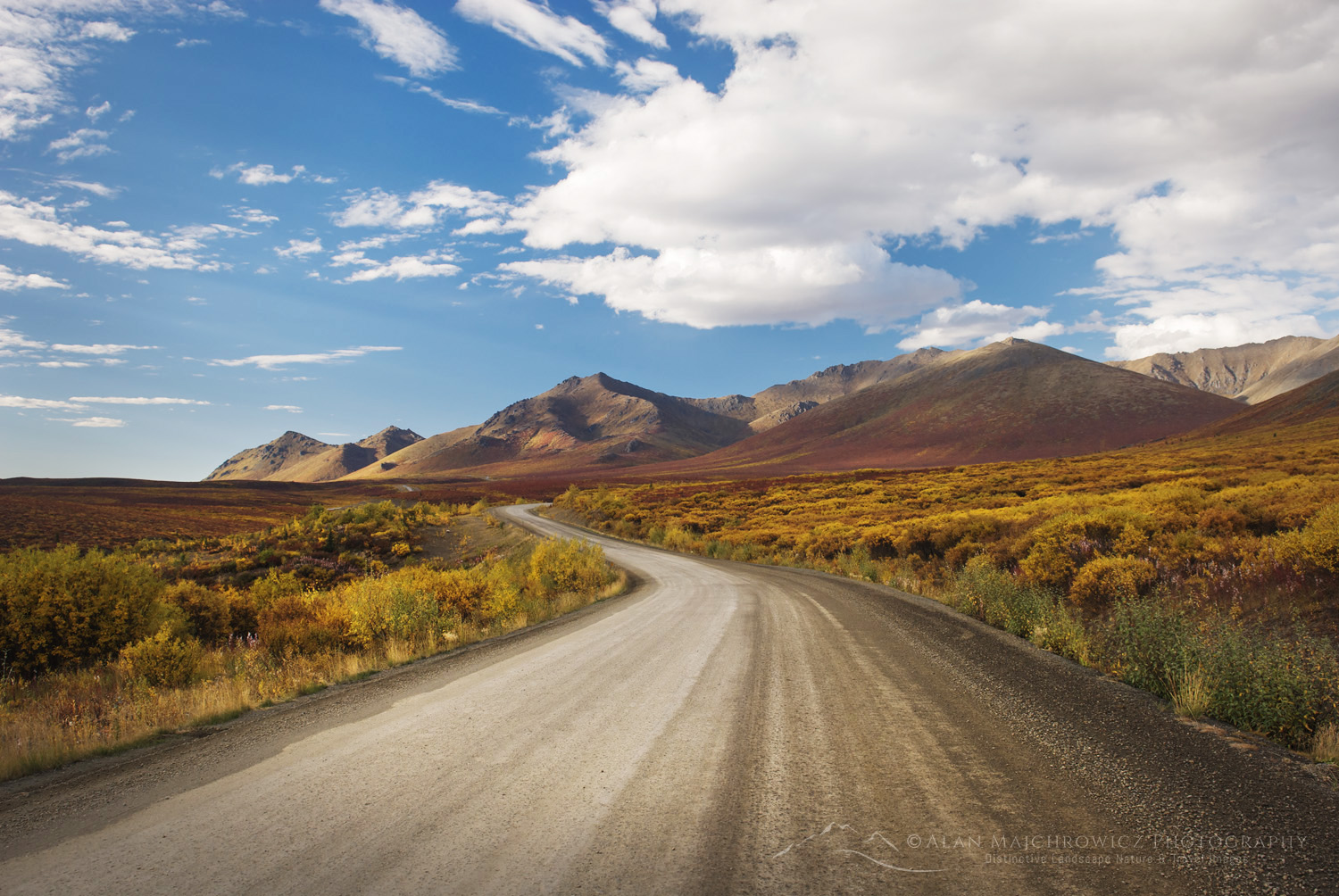
The Dempster Highway winds its way through the Ogilvie Mountains, Tombstone Territorial Park, Yukon, Canada #15390Dempster Highway, Yukon Territory #15390

Summer Photography Adventures Special Fine Art Print Offer 

Would you like to be a part of the Summer Photography Adventures? For a limited time, you can receive a free 11×14 signed fine art print of any image made during this trip! Click this link to take advantage of and learn more about this unique opportunity.

Summer Photography Adventures Locations:

Sunset alpenglow over Russell Peak and Limestone Lakes Basin, Height-of-the-Rockies Provincial Park, British Columbia, Canada #46245 Summer Photography Adventures 2025Limestone Lakes Basin. British Columbia  #46245

Canadian Rockies/Purcells/Selkirks

The first destinations of this leg will be in the Selkirk and Purcell Mountains of British Columbia. Most of these destinations are familiar, as I’ve made many trips to those areas. Next on the schedule will be a seven-day backpacking trip to Limestone Lakes, a spectacular but seldom-visited corner of the Canadian Rockies.

  • Glacier National Park, Hermit Meadows *
  • Silent Lake, Purcell Mountains *
  • Whirlpool Lake, Purcell Mountains *
  • Bugaboos, Purcell Mountains *
  • Limestone lakes, Height of the Rockies Provincial Park **
  • Kananaskis Country
  • Icefields Parkway, Banff and Jasper National Parks

* Overnight Backpacking
** Multi-day Backpacking

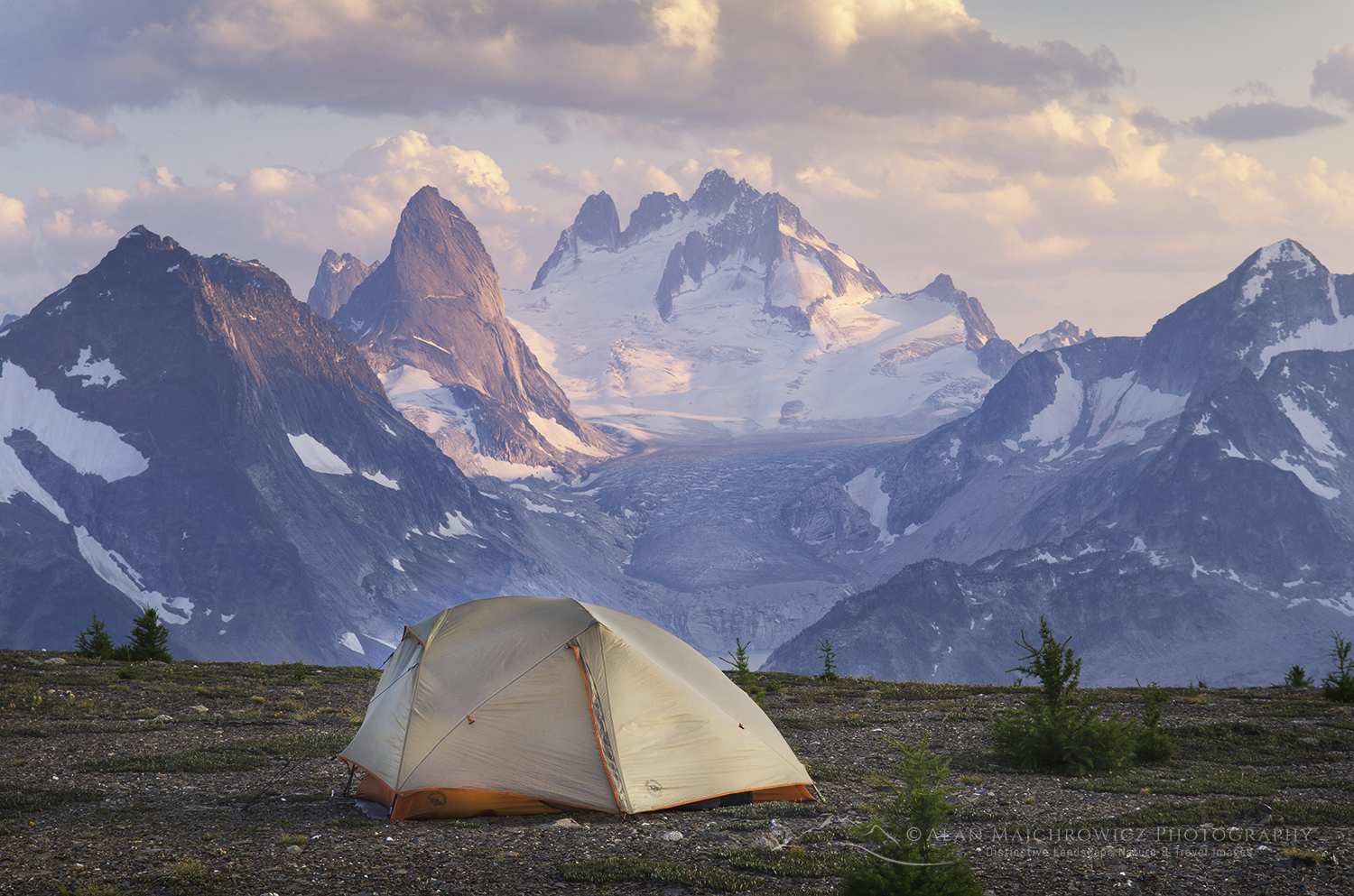
Tent at backcountry camp on Rocky Point Ridge. Howser Towers Vowell Glacier in the distance. Bugaboo Provincial Park, Purcell Mountains, British Columbia. #62962Bugaboos, British Columbia #62962
Northern Canadian Rockies

The second leg of Summer Photography Adventures will take me to the Northern Rockies of British Columbia. This will be my first visit to this remote and wild region of the Canadian Rockies, and I’m excited to have the opportunity to photograph there! This region has a true feeling of immense and raw wilderness that is increasingly rare in destinations further south. And being this far north, there are few roads and established trails.

  • Tumbler Ridge UNESCO Global Geopark
  • Wokkpash Valley, Stone Mountain Provincial Park **
  • Muncho Lake Provincial Park

** Multi-day Backpacking

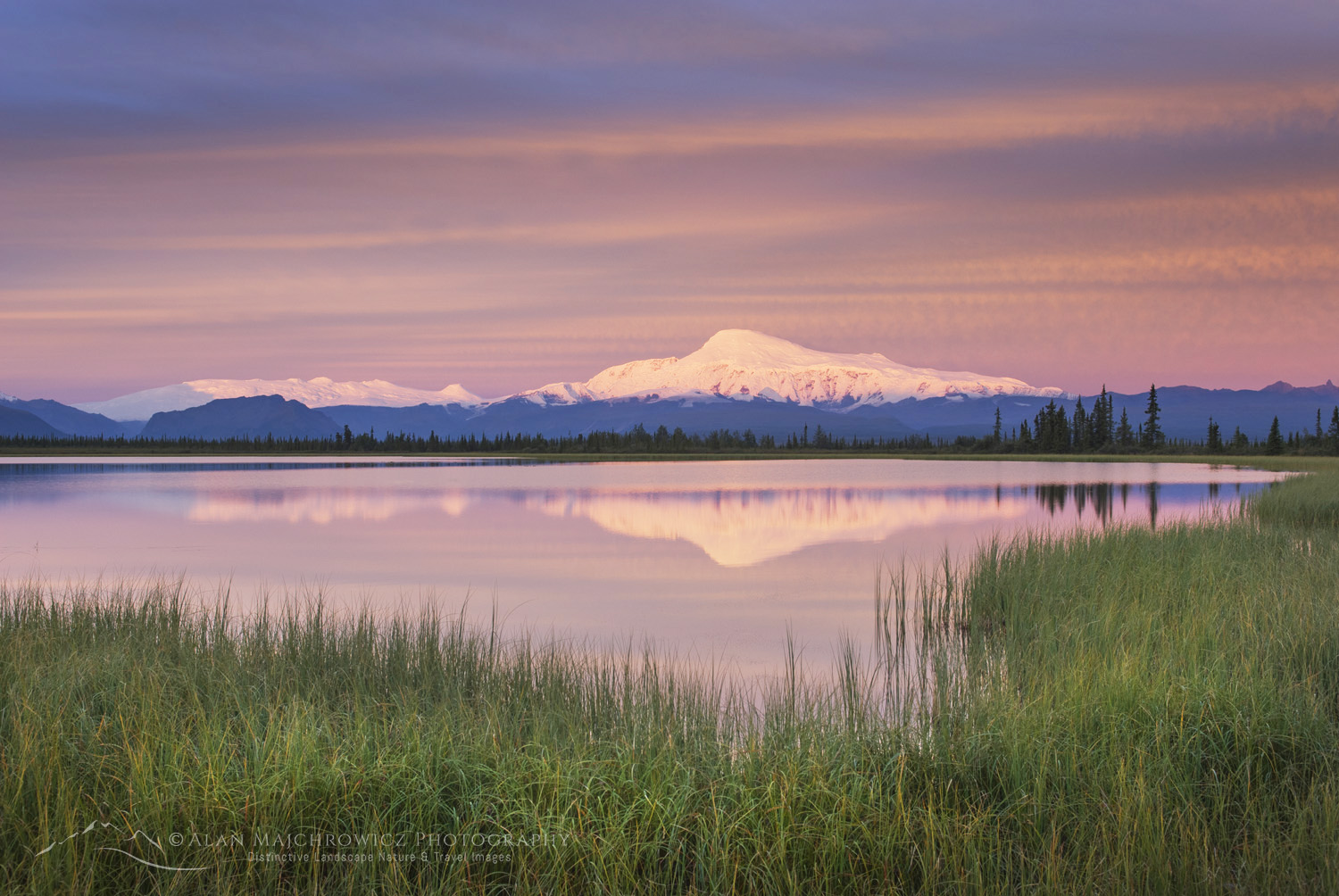
Mount Sanford 16,237 ft (4,949 m) Wrangell-St. Elias National Park, Alaska #14339Mount Sanford, Wrangell St.-Elias National Park #14339

Wrangell-St. Elias National Park, Alaska

Wrangell-St. Elias is a National Park I’ve wanted to return to for many years. On my only visit there, I was awestruck at the raw and wild nature of the landscape and mountains. Even more than the Northern Rockies in British Columbia, Wrangell is an immense park, nearly devoid of roads and trails. Aside from the McCarthy area, getting around the park requires chartering air taxis or grueling cross-country travel across rivers, marshes, and glaciers.

I plan to include the Nabesna Road and McCarthy/Kennecott area. Topping off the visit will be a flightseeing trip over the park’s spectacular glaciers and mountains.

  • Nabesna Road, Mount Sanford, and Wrangell Mountains viewpoints
  • Kennecott Glacier*
  • Flightseeing over Wrangell and St. Elias Ranges

* Overnight Backpacking

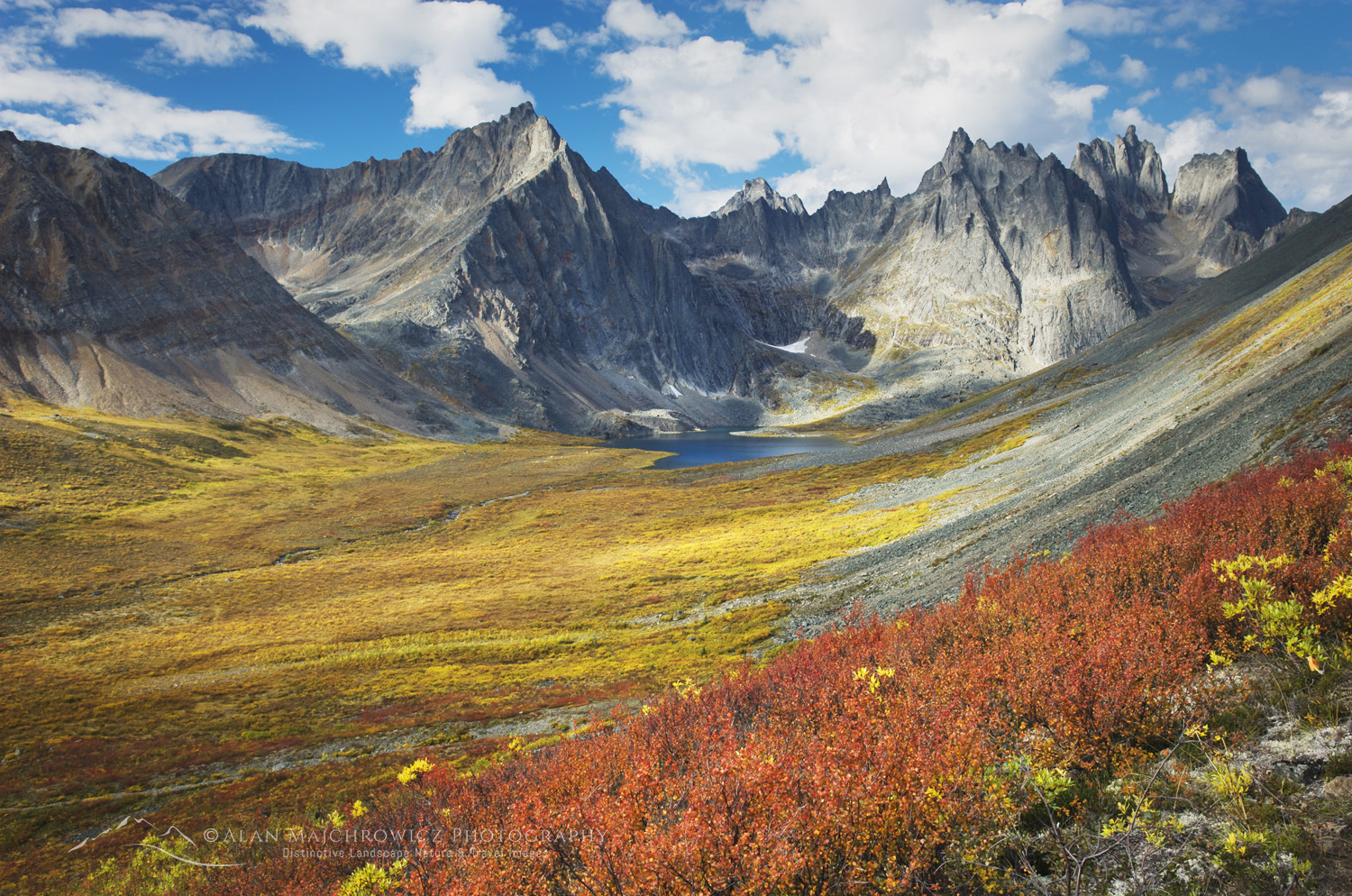
Grizzly Creek valley displaying tundra in full autumn color, Tombstone Territorial Park Yukon Canada #15190Tombstone Territorial Park #15190

Yukon and Northwest Territories

This last leg of the trip promises to be the most exciting, Yukon Territory and the Arctic. After topping up supplies in Dawson City, the route will travel north for 740km along the Dempster Highway to Inuvik, Northwest Territories. But it won’t stop there; another 147km on the Tuktoyaktuk Highway will take me to the shores of the Arctic Ocean! Seeing, dipping in, and even tasting the waters of the Arctic has been a lifelong dream of mine. So I’m beyond excited to have this experience!

However, before reaching this epic conclusion, I have a backpacking trip reserved in Tombstone Territorial Park. This spectacular park is located just a few degrees south of the Arctic Circle and features towering granite spires rising above the tundra and boreal forest.

My multi-day backpacking trip in the park and the drive up the Dempster highway is scheduled to coincide with the peak of fall color in late August. During this period, the tundra is ablaze in yellow, orange, and red, rivalling the best autumn displays of New England.

  • Dawson City
  • Tombstone Territorial Park **
  • Dempster Highway
  • Pingo Canadian Landmark, Tuktoyaktuk Highway
  • Arctic Ocean, Tuktoyaktuk, Northwest Territories

** Multi-day Backpacking

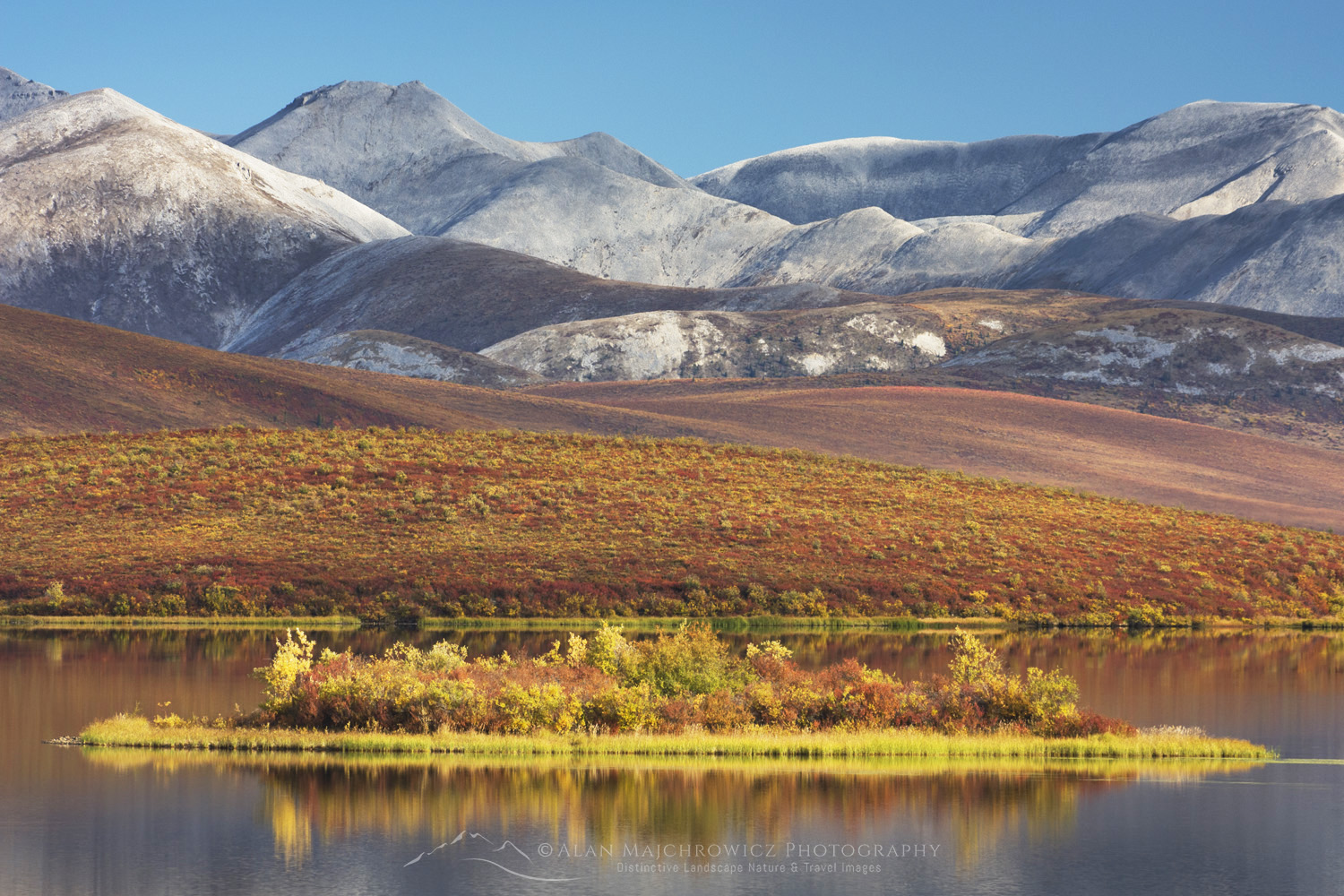
Lake in the Blackstone Plateau reflected clouds and hills of the Ogilvie Range, Yukon, Canada #15390 Summer Photography Adventures 2025Ogilvie Mountains Yukon Territory #15390

All photos appearing in this post are available for Commercial Licensing and Fine Art Prints. Click on any image to purchase, or contact me for more info!


Learn about how to protect the places we love to photograph
Visit the Nature First Website
Nature First the alliance for responsible nature photography

Summer Photography Adventures 2025

Castle Peak North Cascades

Manning Park Winter Photography

Manning Park Winter Photography

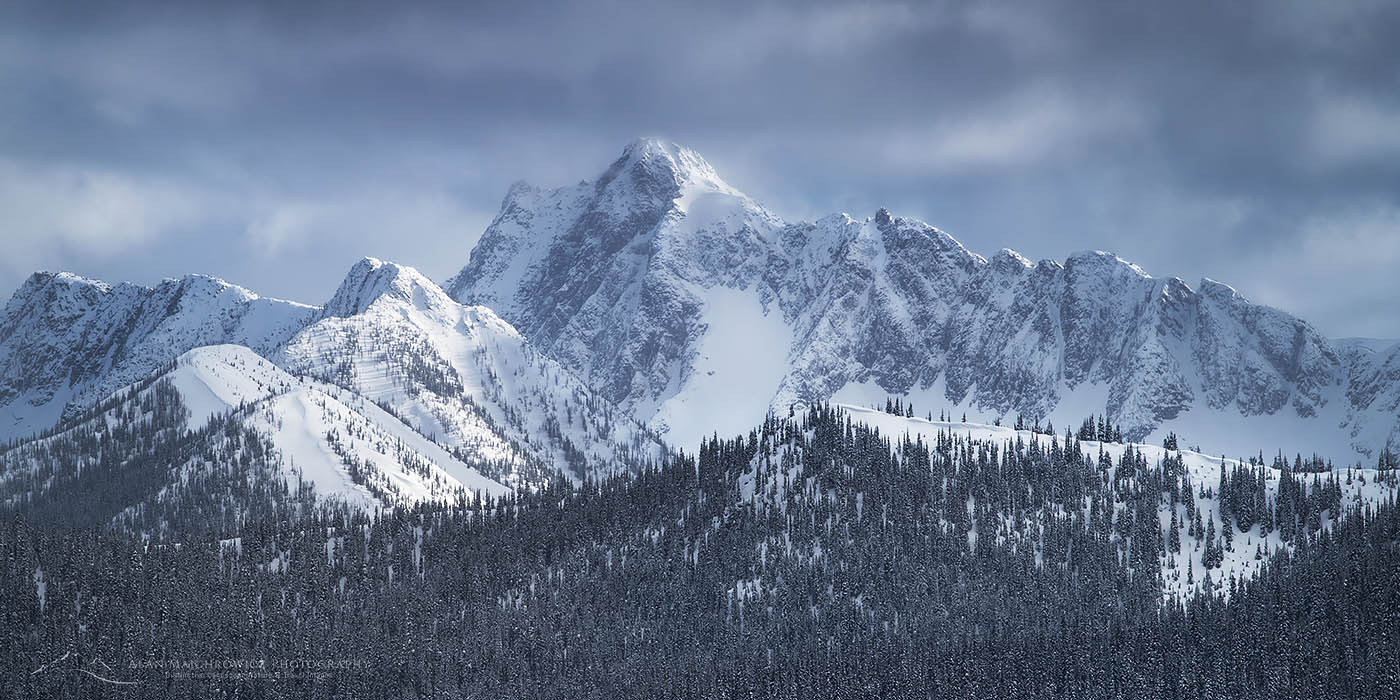
Castle Peak North CascadesCastle Peak North Cascades #64796  Purchase

Last week I made a trip to Manning Provincial Park for winter photography and skiing fun. Weather forecasts were for cold temperatures and a good amount of fresh snow. Perfect conditions to make some new winter photos.

Manning Provincial Park is a large park in southern British Columbia. It encompasses the northern reaches of the North Cascades Mountains, along the U.S. Washington State border. On the U.S. side, the mountains present a rugged appearance with high jagged peaks. However, in Manning Park, the range mellows out into high mountains with more rounded summits. Just north of the park the North Cascades ends, and gives way to the Thompson Plateau.

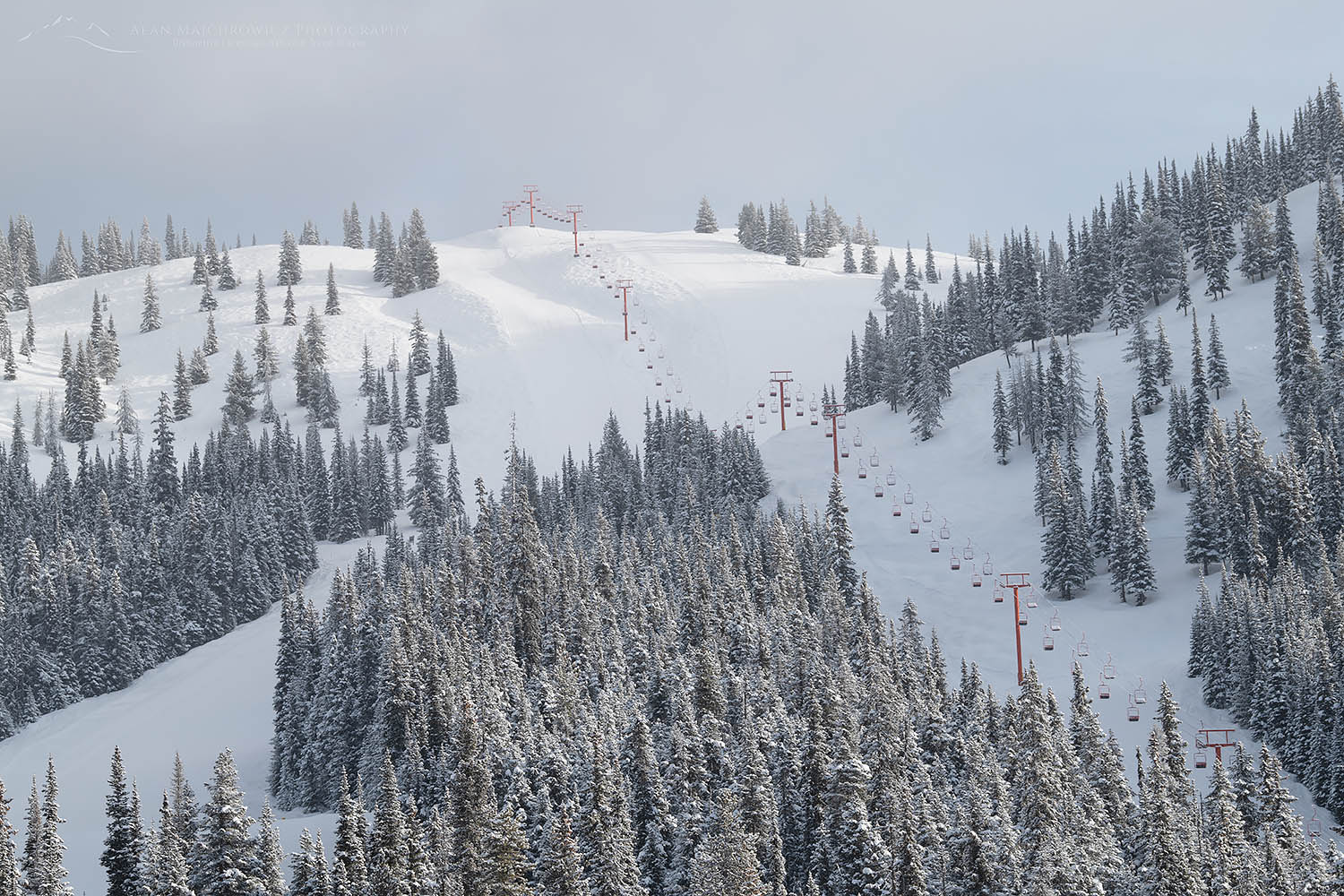
Gibson Pass Ski Area, Manning Provincial ParkGibson Pass Ski Area Lifts  #64771  Purchase

Skiing Manning Park

In summer, hikers in Manning Park can find some great trails offering high views and meadows of wildflowers. In winter, the park offers a network of cross-country ski trails in addition to the small Gibson Pass downhill ski area. Backcountry skiers and snowshoers can also find fresh snow and solitude on the Fat Dog ski route to the Brothers Mountain group.

On this trip, I took advantage of both the Nordic trails and the downhill ski runs. Manning Park’s Gibson Pass Ski Area offers a bit of a unique experience in the Pacific Northwest. Most ski areas in this region receive a copious amount of heavy wet snow, often referred to as Cascade Concrete. Manning Park, on the other hand, often has colder powdery snow due to its more inland location.

A few other things set Manning apart. For one, it has a laid-back retro feel, perfect for families and avoiding adrenaline junkies. Also, while the big resorts like Whistler Blackcomb charge a staggering $180 (Canadian) for a single lift ticket, Manning charges only $59 (Canadian). Plus, there are usually no lift lines. On my recent midweek visit, I skied directly onto the chair each time! The downside to these benefits is that there are only two chair lifts, with only one operating on midweek. The vertical drop is a modest 1400′.

North Cascades Winter, Manning Provincial ParkManning Park in Winter  #64780  Purchase

Winter Photography in Manning

While the Nordic trails are fun, they usually don’t offer much in the way of landscape photography. Therefore, I made a point of taking advantage of the views offered from the top of the ski lifts. From the ridge top, the views south into the Washington North Cascades are very good. The two dominant peaks in that direction are Hozomeen Mountain and Castle Peak. Further west are the jagged peaks of Mount Spickard, Mox Peaks, and the northern Pickets, in North Cascades National Park. To the north are the rounded summits of Three Brothers and Big Buck Mountains.

To photograph the twin summit towers of Hozomeen and the Pickets, you’ll want to be on the ridge top early in the morning. However, unless you hike up to the ridge before dawn, you’ll be limited by the ski lift schedule. The lifts open at 9:00 so you’ll miss the sunrise. Of course, depending on lighting and snow conditions, you can still make good photos throughout the day. If you want to get to the top only for the views, you can purchase a one-trip lift ticket.

Later in the afternoon, both Castle and Frosty Mountains will begin to receive warmer light. Note that until late spring, the north faces of Castle and Hozomeen will be mostly in shadow.

North Cascades Winter, Manning Provincial ParkManning Park in Winter  #64783  Purchase

Timing is Everything

While having great light is always imperative in photography, another important consideration for winter photography is timing the snow conditions. In winter, most of the landscape will have a blanket of snow over it. However, trees and forests without snow on them will become black holes for light against all that white.

In my opinion and experience, the best conditions can be had just after a storm dumps fresh snow on the trees. This sounds simple and obvious, but it can be tricky. Often in the Northwest, a warmer, wet snowstorm is followed by sunny conditions, which melt snow off tree branches very quickly. That pristine scene can be gone within a few hours!

Frosty Mountain North Cascades British ColumbiaFrosty Mountain Manning Park  #64791  Purchase

Colder drier locations such as the Rockies present another dilemma. The snow can be so cold and dry that very little to no snow may adhere to tree branches. Unlike the coastal Northwest where wet snow acts like glue on everything. In cold locations and conditions, a slight breeze can also remove the snow as easily as warm sunshine.

In the end, winter photography can be more fickle than photographing spring wildflowers or perfect autumn colors. Depending on weather patterns where you live or are able to travel, there may be only a couple of good opportunities a season. So keep a close eye on those forecasts and be ready to go at a moment’s notice!

North Cascades Winter, Manning Provincial ParkManning Park in Winter  #64778  Purchase

If You Go to Manning Park

Driving time to Manning Park is about 4.5 hours north of Seattle, and two hours from Vancouver. Winter camping is available, as are RV hookups at Gibson Pass Ski Area. Manning Park Resort also offers excellent lodge and cabin facilities, along with a restaurant, grocery store, and gas. Cell phone signal is limited to the immediate lodge area.

Want to Learn More?

Would you like to learn more about photographing in Manning Park and or winter photography? I offer full-day, half-day, and multi-day photo tours and instruction. Check out my Private Instruction/Tours page for more info, or contact me directly. I would love to help you take your photography to the next level and shoot like a pro!

Alpenglow over Marriott Basin, Coast Mountains British Columbia

Marriott Basin British Columbia

Marriott Basin British Columbia

Alpenglow over Marriott Basin, Coast Mountains British ColumbiaMarriott Basin alpenglow, #61843    Purchase

Last month I made my third trip to Marriott Basin, in search of new landscape images. Hot on the heels of my recent trip to Whatcom Pass, I wanted to get in as many backpacking photo trips as possible before wildfire smoke returned. This season has been one of the worst in history for wildfires. Both in the western United  States and British Columbia numerous large fires are burning.

Located in the southern Coast Mountains of British Columbia, Marriott Basin is an extensive alpine area. Access to the area is from Cayoosh Pass on Highway 99, about an hour’s drive east of Pemberton. Nearby is the extremely popular Joffre Lakes Provincial Park. While the lakes are popular with sightseers and day hikers, the Joffre Group of peaks is wildly popular with climbers and backcountry skiers.

Marriott Basin and Wendy Thompson Hut

Generally above 6000′ Marriott Basin contains several lakes and numerous peaks for climbing, most notably Marriott Peak. My previous trips to Marriott Basin entailed one overnight backpack to Mount Rohr, technically outside the basin. The other was a winter ski trip to the Wendy Thompson Hut, located at the head of the basin. The Wendy Thompson Hut is operated by the Alpine Club of Canada and is open year-round. However, the hut sees most of its visitors during the winter and early spring ski season.

Getting into Marriott Basin is fairly straightforward, with summer access being slightly different from winter. In summer you can drive a couple of miles up a brushy gravel secondary road to the trailhead. Parking and turnaround space is extremely limited and you may need back down the road to find a spot. The total length into the basin from trailhead to the hut is around five miles with about 2000 feet of elevation gain. I say around and about since I don’t carry a GPS and rely on maps and online trail guides instead. Depending on your fitness and pack weight the hike can be from 2-4 hours.

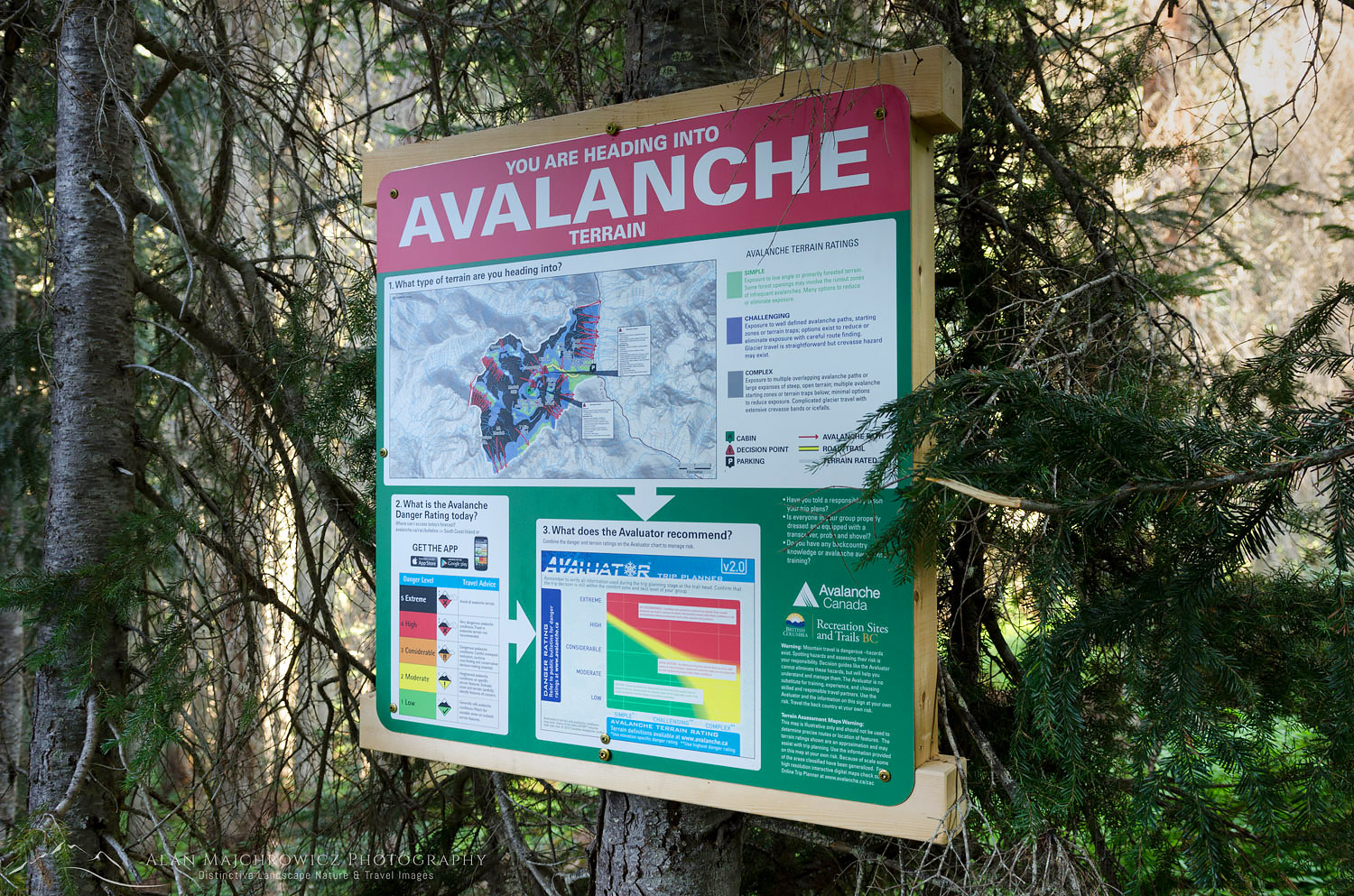
Avalanche warning sign Coast Mountains British ColumbiaTrailhead avalanche warning #61910    Purchase

Marriott Basin British Columbia Trail

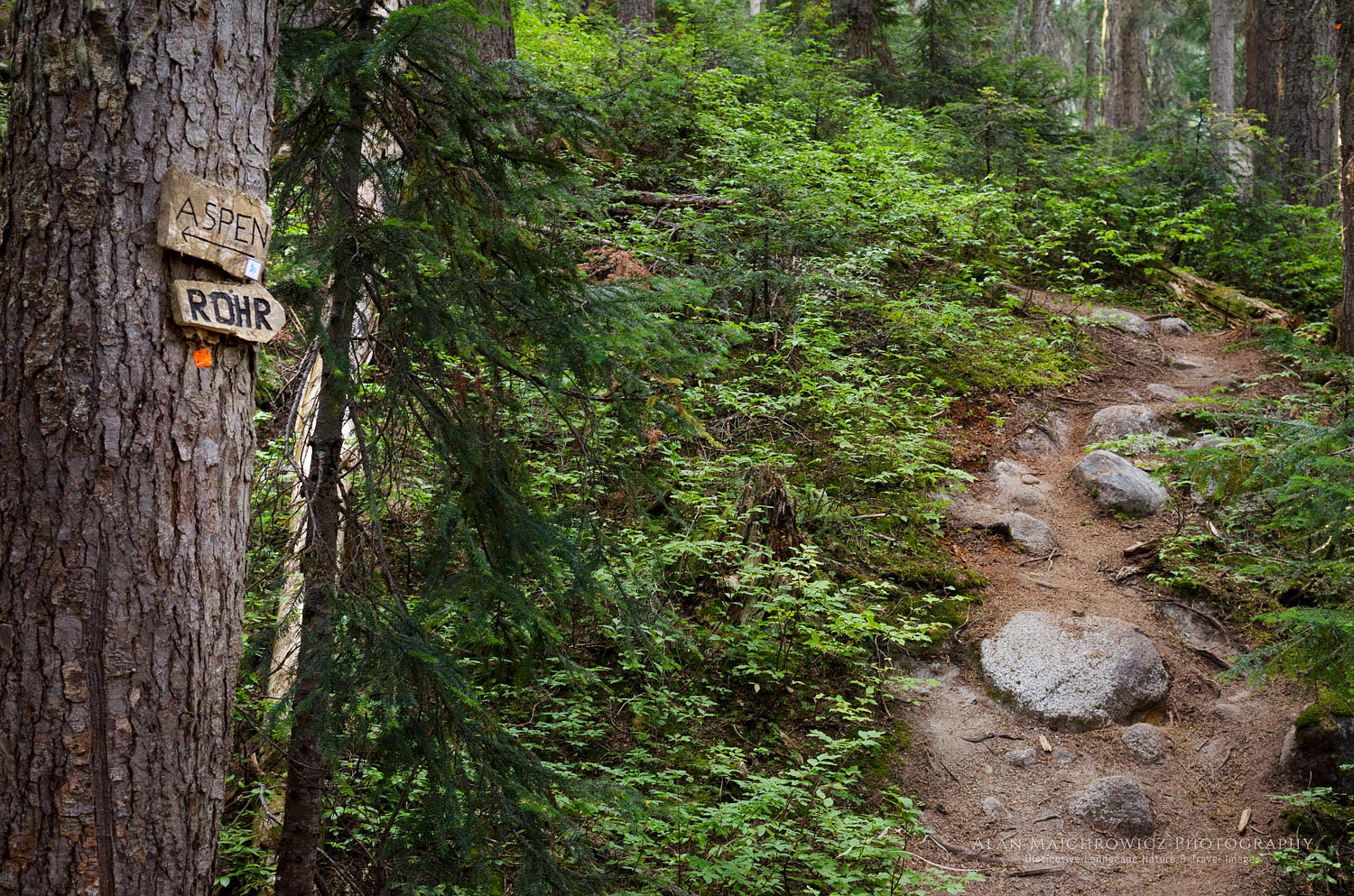
Posted at the trailhead is a large sign warning of and explaining avalanche hazards, which generally is of no consequence in summer. Hikers accustomed to hiking on U.S. trails in the Pacific Northwest may be in for a rude awakening. Well-marked and easy to follow, the trail receives very little maintenance. Climbing over logs around boulders and muddy areas the trail is pretty rough in places. After a short level spell, the trail climbs a headwall very steeply, without switchbacks, through the forest. Near the top of this section is the turnoff for Rohr Lake and Mount Rohr. From here the trail levels off a bit and zigzags around muddy bogs and small meadows until a tricky log crossing of a stream. On my visit the water was low but in late spring or early summer, the crossing must be quite exciting!

Marriott Basin trail Coast Mountains British ColumbiaMount Rohr junction #61905    Purchase

Marriott Basin trail Coast Mountains British ColumbiaCreek crossing, Marriott Basin Trail  #61892    Purchase

The next section of the trail climbs into the subalpine zone, or the boulder zone as I call it on this trip. As soon as you start breaking out of the trees the trail is almost constantly negotiating rocks and boulders. The constant ups and downs and zigzagging can be very tiring, especially in warm weather. However, the views also begin to open up now, above the ridge tops and over to green Marriott Lake. After reaching the far end of the lake the last bit of climbing to the hut begins. Again, depending on your pack weight this section can feel short or agonizingly long. In all, it’s less than a mile and 200′ higher up. A level boulder-filled meadow with a meandering stream is home to the hut.

Wendy Thompson Hut British ColumbiaWendy Thompson Hut  #61793    Purchase

Wendy Thompson Hut

The upper lakes were my ultimate destination, so I only paused briefly for a rest and inspection of the hut. Wendy Thompson was a ski patroller and paramedic. She died tragically in 1995 at the age of 33 in a Medivac flight crash in the Queen Charlotte Islands. As a memorial and legacy to Wendy, her parents, and the ACC worked with volunteers to build this hut.

Since my last winter visit, the ACC made some substantial renovations. They extended the entire length and added solar-powered lighting and USB ports. They also replaced the obnoxious smell of kerosene heaters with a wood-burning stove. As is usual in backcountry huts one of the tables was covered in maps, guidebooks, and misc. reading material. Also present was the obligatory cribbage board and multiple decks of cards.

From the hut, the work begins again. Access to the upper lakes is via more and bigger boulder fields without the benefit of a trail. Some well-placed rock cairns mark the way but mostly it’s a pick-your-own-best route deal. Once at the upper lakes, it is wide open wandering in all directions. I set up camp in a spot suitable for easy access to photo ops of the distant peaks and valleys below.

Boulders Marriott Basin Coast Mountains British ColumbiaBoulder field, cairn visible in lower right corner  #61849    Purchase

Upper Marriott Basin

The next day I did some exploring and I set my eyes on an easy ridge within my comfort level. Hiking and easy scrambling over boulder slopes brought me to the crest with a new view to the west and north. One of the reasons I picked this particular ridge was for the unobstructed views of Cayoosh Mountain. Sitting at 8200″Cayoosh is a fairly bulky chunk of rock with the north and east aspects covered in glaciers. Looking down between me and Cayoosh was a high pass with a small green lake. To the north was a long deep valley with countless peaks on the horizon. Taking in such a view I immediately wished I had my camp set up here! Photographing in good light would be spectacular. I guess I will need to make another trip back sometime.

Later, back at my camp, I settled in to wait for the evening light. Although the sky was mostly free of clouds, there was some nice alpenglow present, which enabled me to take a few photos. It was nice to watch the progression of layered colors after sunset. First came yellows and oranges, followed by purples and blues of the Belt of Venus.

Backcountry camp Coast Mountains British ColumbiaCamping in Marriott Basin #61795    Purchase

Cayoosh Mountain Coast Mountains British ColumbiaCayoosh Mountain #61805    Purchase

Marriott Basin Coast Mountains British ColumbiaUpper Marriott Basin #61815    Purchase

Back at the Hut

The next day I had planned to hike out to my truck but on exploring the area near the hut I decided to stay an extra night. Near the hut were small grassy meadows and a small stream among more boulders. I found a nice campsite near the small stream which held potential for some nice photographic compositions. I tried to take some evening photos but the light was bland, especially with no clouds. In the morning it was apparent that the winds had shifted. Smoke once again began to creep across the sky. Although there still weren’t any clouds the light was a bit nicer, with the smoky haze giving a more pastel hue to the scene. I set up my tripod in a few predetermined places and came away with several more photos.

I had a quick breakfast and packed up my gear. Although I wasn’t as successful with photos as hoped I did have a great time. And I did manage to find a new view that was worthy of a return trip.

Backcountry camp Coast Mountains British ColumbiaMarriott Basin Camping #61863    Purchase

Marriott Basin, Coast Mountains British ColumbiaMarriott Basin #61871    Purchase

Lower Marriott Lake Coast Mountains British ColumbiaSmokey haze over Marriott Lake #61884    Purchase

Leave No Trace

Please, Please, Please!  Don’t plan a trip to this or any other national park, monument, or wilderness area unless you are prepared to follow Leave No Trace guidelines (LNT). National parks and wilderness areas worldwide are under incredible pressure from the growing number of visitors. So, please do your part to help preserve these precious areas for future generations!

Please visit the Leave No Trace Center for Outdoor Ethics to learn more about LNT’s principles. Your children and grandchildren will thank you!

LEAVE NO TRACE SEVEN PRINCIPLES

1. Plan and Prepare
2. Travel and Camp on Durable Surfaces
3. Dispose of Waste Properly
4. Leave What You Find
5. Minimize Campfire Impacts
6. Respect Wildlife
7. Be Considerate of Other Visitors
© Leave No Trace: www.LNT.org

Learn about how to protect the places we love to photograph
Visit the Nature First Website
Nature First the alliance for responsible nature photography


All photos appearing in this post are available for Commercial Licensing and Fine Art Prints. Click on any image to purchase, or contact me for more info!

Marriott Basin British Columbia

Marriott Basin trail Coast Mountains British Columbia

Coast Mountains

How to tell if you’re hiking in the Coast Mountains trail of British Columbia:

  1. State of the art bridges over creek crossing
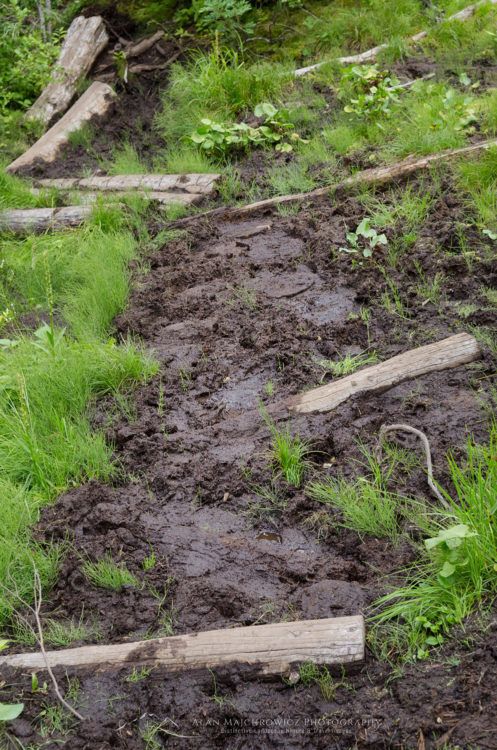
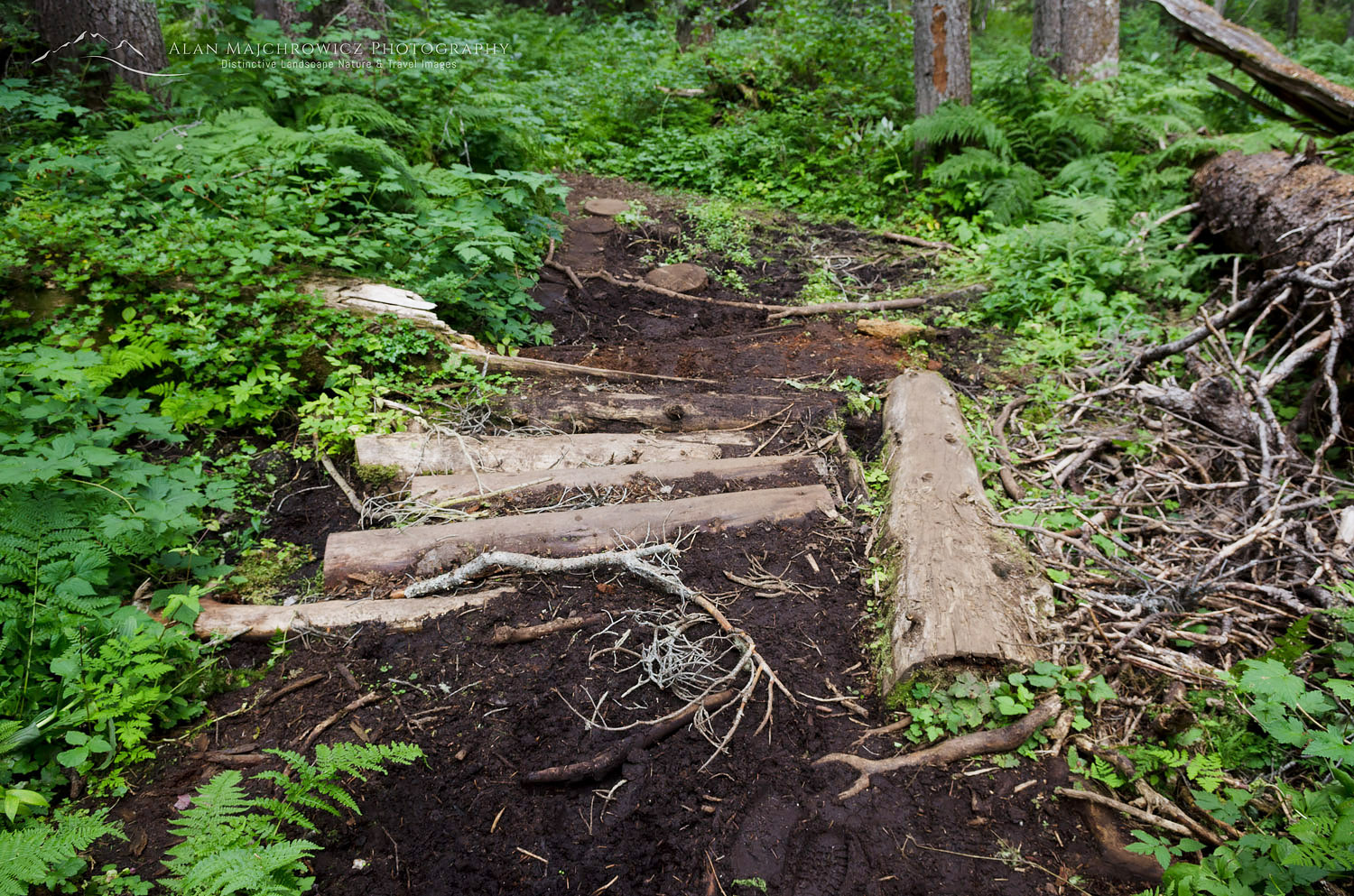
  2.  Deep mud with slippery logs and branches strategically placed for optimum ankle twisting

I actually love these types of trails, there’s a sense of  true wilderness about them, unlike some of the crowded super highway trails found in Washington and Oregon. These pics are from a few days ago during a visit to Marriott Basin in the Coast Mountains.

I have lots of new photos in the works from this and my previous trip to North Cascades National Park. Stay tuned you’re going to love them!!

Marriott Basin trail Coast Mountains British Columbia


Marriott Basin trail Coast Mountains British Columbia

Mount Robson Canadian Rockies

Mount Robson Canadian Rockies

Mount Robson Canadian Rockies

   Mount Robson Canadian Rockies British ColumbiaMount Robson Canadian Rockies British Columbia #54613 Purchase

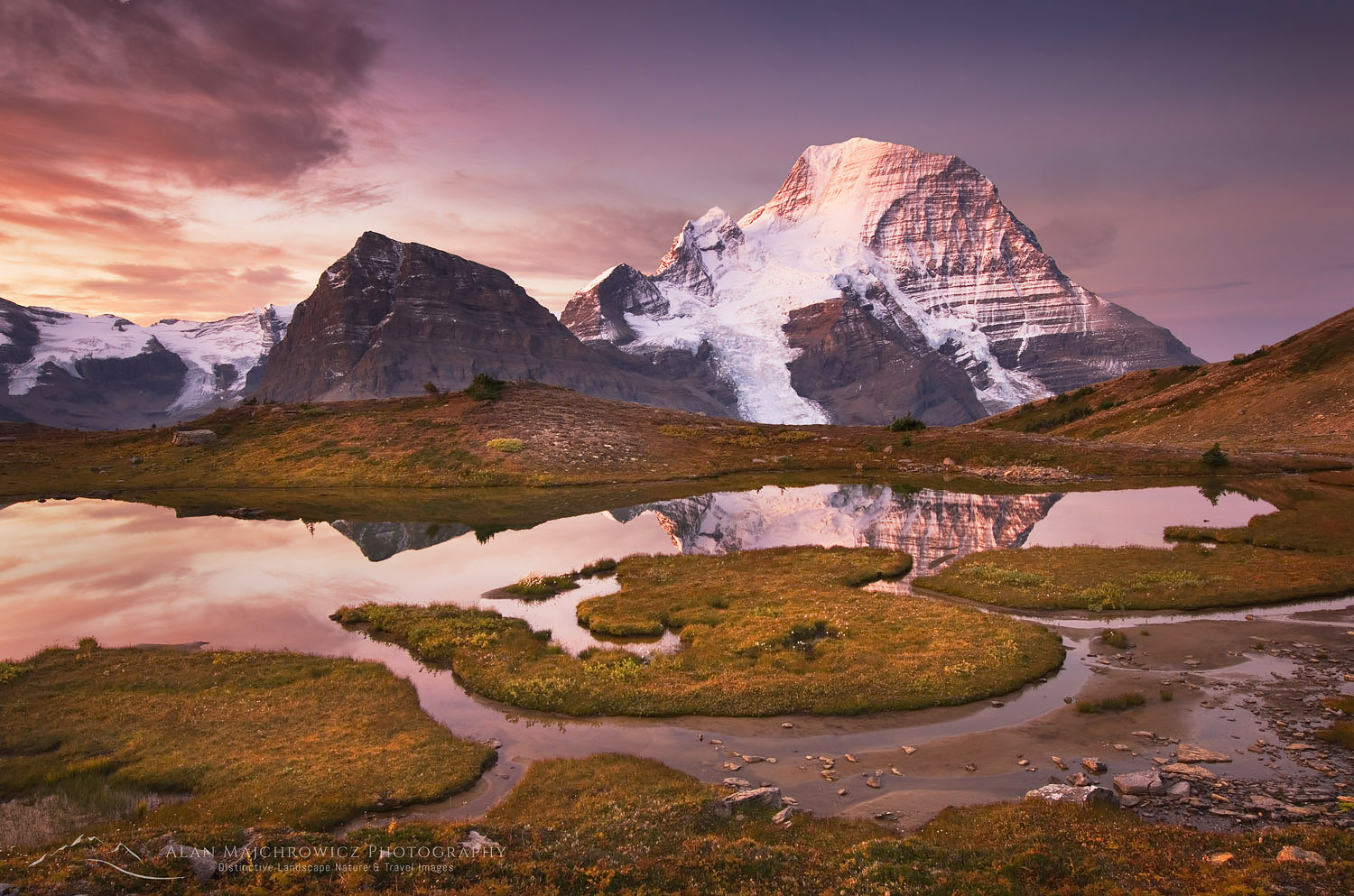
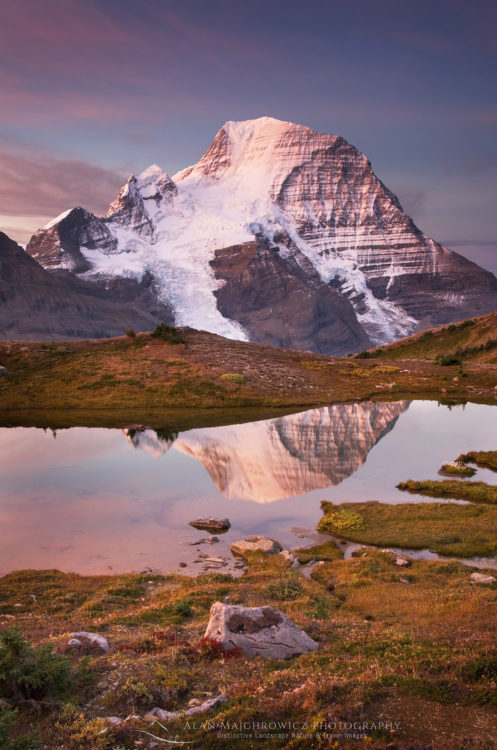
Here is another image from last September’s trip to Mount Robson in the Canadian Rockies, since this image has garnered an exceptionally favorable response on social media I felt that I should fill in a little background on how it was made. This was my third trip to Mount Robson Provincial Park and I had high hopes of getting some stunning images of the mountain. I had allocated five days to fulfill my goal. However, by the third day I was becoming frustrated by the lack of interesting light. The weather was spectacular, warm with blue skies. But while great for outdoor activities it didn’t possess the kind of light I had hoped for. Finally on the third morning clouds from an approaching storm arrived just as the sun was coming up. Perfect timing and conditions to illuminate the sky and mountains in a warm glow. Just what I wanted!

Mount Robson sunrise Canadian Rockies British ColumbiaMount Robson Canadian Rockies British Columbia #54615 Purchase

The images above were some of the first made as the sky warmed with a reddish magenta glow. I had thoroughly investigated this spot the day before to see where and how the best compositions lined up. I knew there were many possibilities for both horizontal and vertical images. So I mentally took note on which were the best and planned the shoot accordingly if the light cooperated. This plan paid off the next morning as I knew there would be a limited amount of time before the light began to fade.

By the time I had finished working this area the light was still going strong. About a half mile east along this basin there was another spot I planned on photographing in the evening or next morning. With the approaching weather I had a feeling there might not be another opportunity like this one. So I gathered up my equipment and ran along the basin as fast I could, and hastily set up my tripod. By this time most of the warm dawn glow had faded but the light was still intense on the clouds. The third image in this post  is one of the last from that morning. The post processing was nothing more than adjusting levels and curves with some burning and dodging. I like to keep things on that end as simple and strait forward as possible.

Mount Robson Canadian Rockies British Columbia Mount Robson Canadian Rockies British Columbia #54646   Purchase

Mount Robson Canadian Rockies British ColumbiaMount Robson Canadian Rockies British Columbia #54651r   Purchase

Icemaker Mountain Coast Mountains British Columbia

Athelney Pass Coast Range British Columbia

Athelney Pass Coast Range British Columbia

This article was originally posted back in August of 2008. Since my main summer photography trip for 2014 will be an extended visit to several very remote and seldom visited areas in British Columbia, I felt it appropriate to bring this one back to light. To date, this trip to the Athelney Pass Coast Range British Columbia was one of my favorite and most exciting in recent years. Despite an abundance of National Parks and Wilderness Areas in the Pacific Northwest, it is getting harder every year to find a place to visit and photograph that is relatively unknown and has a truly remote wilderness feel. The Athelney Pass/Salal Creek area fits the bill in all aspects, even though it has no wilderness park or protected area designation.
Update 2025: I still haven’t been back, sigh…

Begin original 2008 post:

Icemaker Mountain Coast Mountains British ColumbiaMount Ethelweard and  Icemaker Mountain #18242   Purchase

For the last six days, I’ve been working on editing all the new images from my recent trip to Athelney Pass in British Columbia’s Coast Range. This trip was one of the best and most productive amongst a string of excellent photo trips in 2008. So it’s worth adding a few words and pics about it. I was vaguely aware of this area until early last month while researching nearby Coast Mountain routes and trails on the web. It only took seeing a couple of photos on Google to convince me to make a trip there.

Salal Creek Coast Range British ColumbiaSalal Creek Coast Mountains British Columbia #17884

Researching Athelney Pass in a couple of guidebooks revealed that it wasn’t too far away. Just a 4-5 hour drive north of Bellingham. I felt four to

six days would provide ample time for exploration and photography. Unfortunately (or maybe fortunately) there is no formal trail leading into this rugged wilderness. Meaning that the hike to Athelney Pass is only a modest 8-10 or so miles in length and 2200 feet elevation gain. However, it felt like it was about twice that much.

Athelney Pass Coast Range British ColumbiaAthelney Pass Mountains British Columbia #19083  

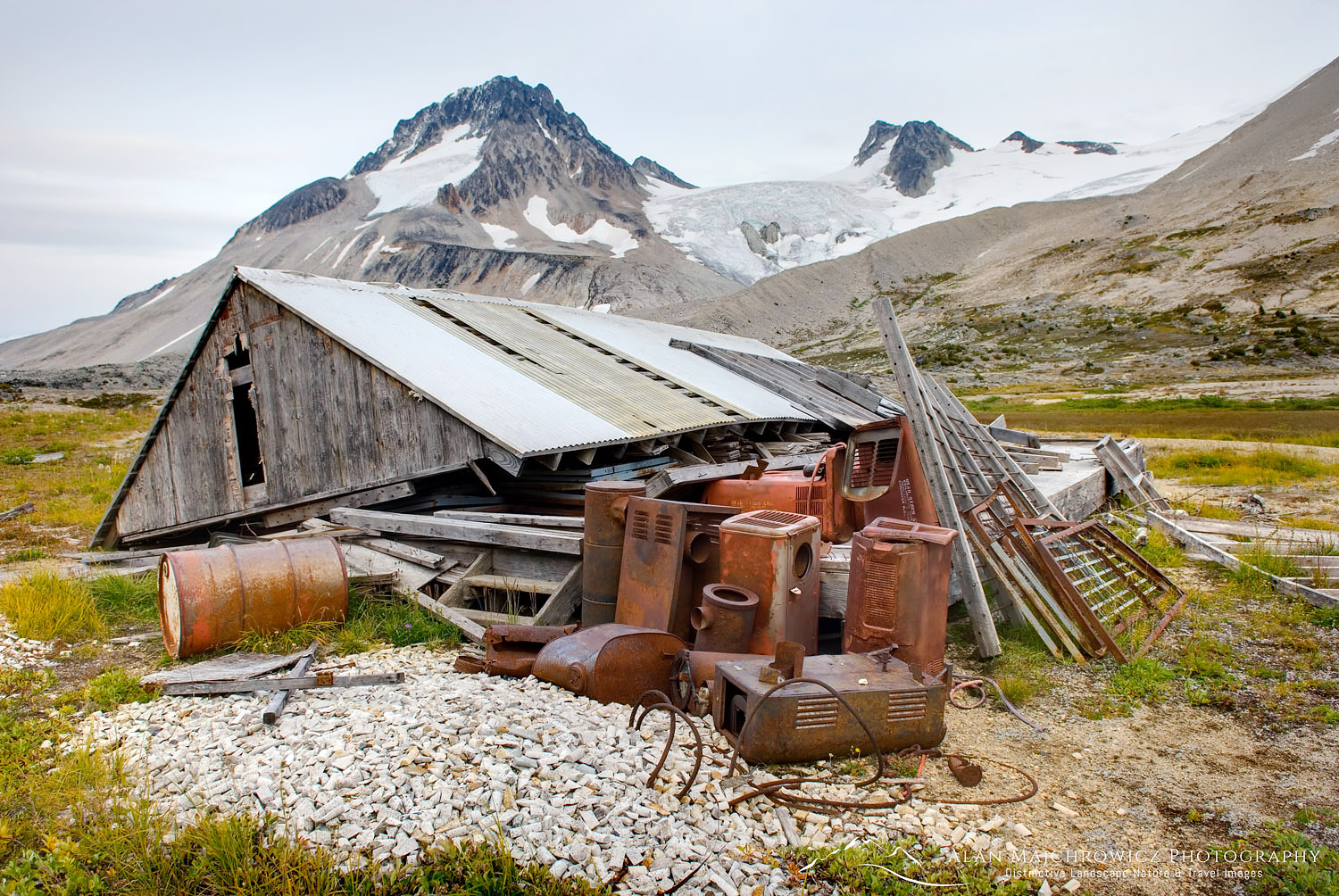
Mining cabin Coast Range British ColumbiaDerelict mining cabin and equipment at Athelney Pass #17979   Purchase

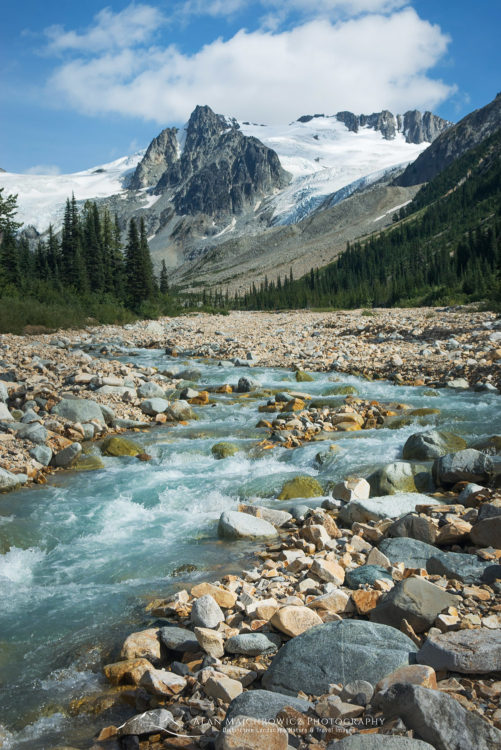
There are several sections requiring route-finding in the forest. Along with a couple of torturous sections of bashing through thick nearly impenetrable slide alder. The rest of the route is “easy” hiking in open country along the river bank and steep loose glacial moraines. If your definition of easy is hiking for miles on unstable ankle-breaking rocks the size of baseballs and bowling balls! All of this plus a lengthy logging road access meant that I had the whole area mostly to myself. I only saw one other person in six days and that was from a distance. The only other downside to this trip was encountering discarded items from past mining exploration.  There is a derelict cabin rusting equipment, plus discarded barrels of fuel higher up the ridge.  (By 2014 all this may have been cleaned up since my 2008 visit)

Athelney Pass Coast Mountains British ColumbiaAthelney Pass British Columbia #18127  Purchase

As an added bit of excitement, I came across a very large Grizzly Bear on the road as I was driving out after the hike. I’ll never doubt the speed at which these animals can run. I was driving a gravel road when it burst out of the brush in front of my vehicle. It took off down the road at an accelerating speed before disappearing into the brush again.

So if you are looking for a new place to go hiking away from the crowds with a true feeling of raw wilderness, and don’t mind putting in the extra effort this area might be for you.

Icemaker Mountain Coast Mountains British ColumbiaIcemaker Mountain  British Columbia #18270  Purchase

Mount Ethelweard Coast Mountains British ColumbiaMount Ethelweard  British Columbia #18545   Purchase

Salal Divide, Coast Range British ColumbiaSalal Divide British Columbia #18545   Purchase

All photos are available for purchase as fine art prints or for commercial licensing. Just click on the desired image and then click Add to Cart to select your option.

Thanks, and please share if you like it!

Leave No Trace

Please, Please, Please!  Don’t plan a trip to this or any other national park, monument, or wilderness area unless you are prepared to follow Leave No Trace guidelines (LNT). National parks and wilderness areas worldwide are under incredible pressure from the growing number of visitors. So, please do your part to help preserve these precious areas for future generations!

Please visit the Leave No Trace Center for Outdoor Ethics to learn more about LNT’s principles. Your children and grandchildren will thank you!

LEAVE NO TRACE SEVEN PRINCIPLES

1. Plan and Prepare
2. Travel and Camp on Durable Surfaces
3. Dispose of Waste Properly
4. Leave What You Find
5. Minimize Campfire Impacts
6. Respect Wildlife
7. Be Considerate of Other Visitors
© Leave No Trace: www.LNT.org

Learn about how to protect the places we love to photograph
Visit the Nature First Website
Nature First the alliance for responsible nature photography


All photos appearing in this post are available for Commercial Licensing and Fine Art Prints. Click on any image to purchase, or contact me for more info!

Marriott Basin, Coast Mountains British Columbia

Marriott Basin Winter Photography

Marriott Basin Coast Mountains Winter Photography

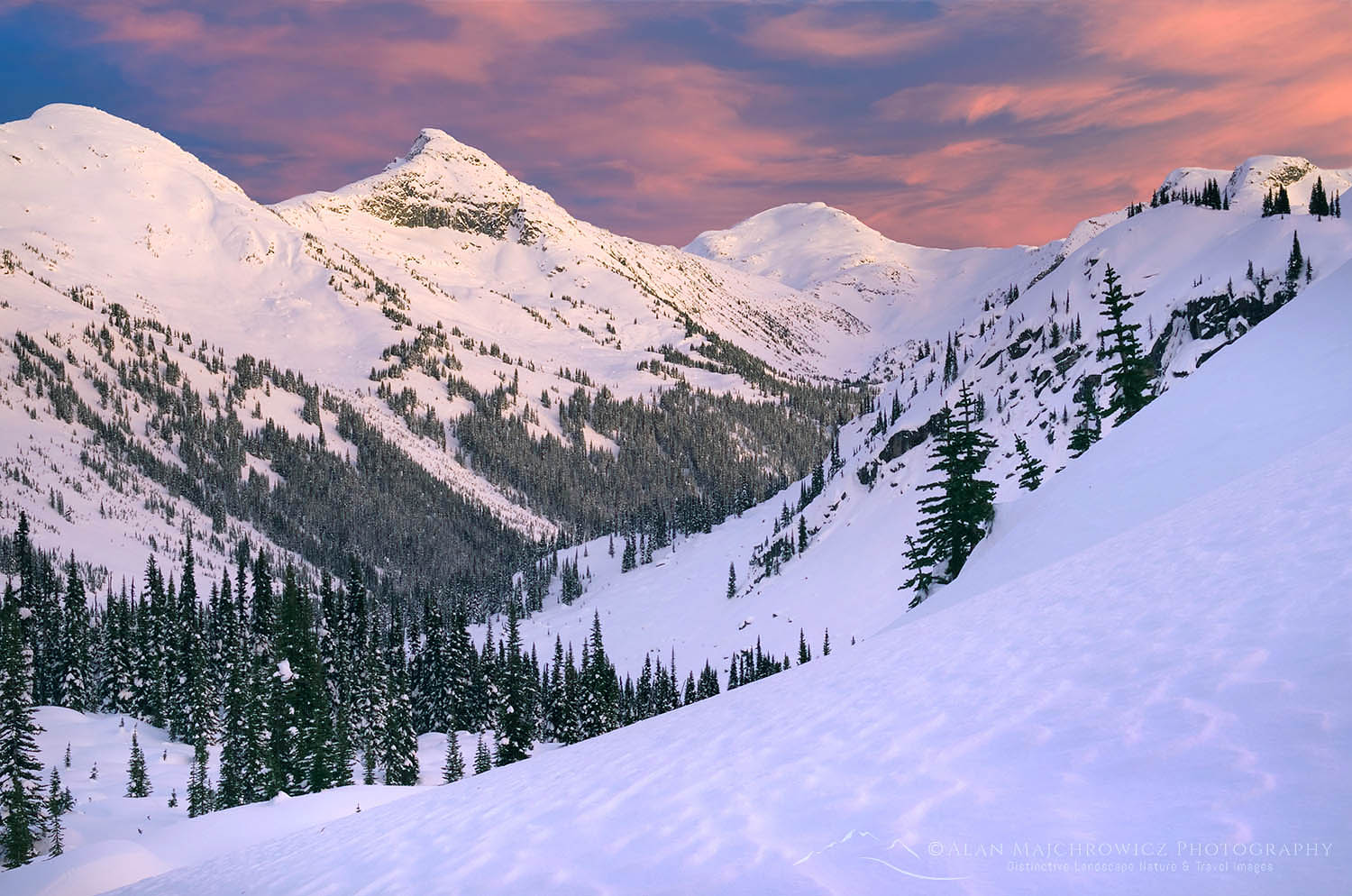
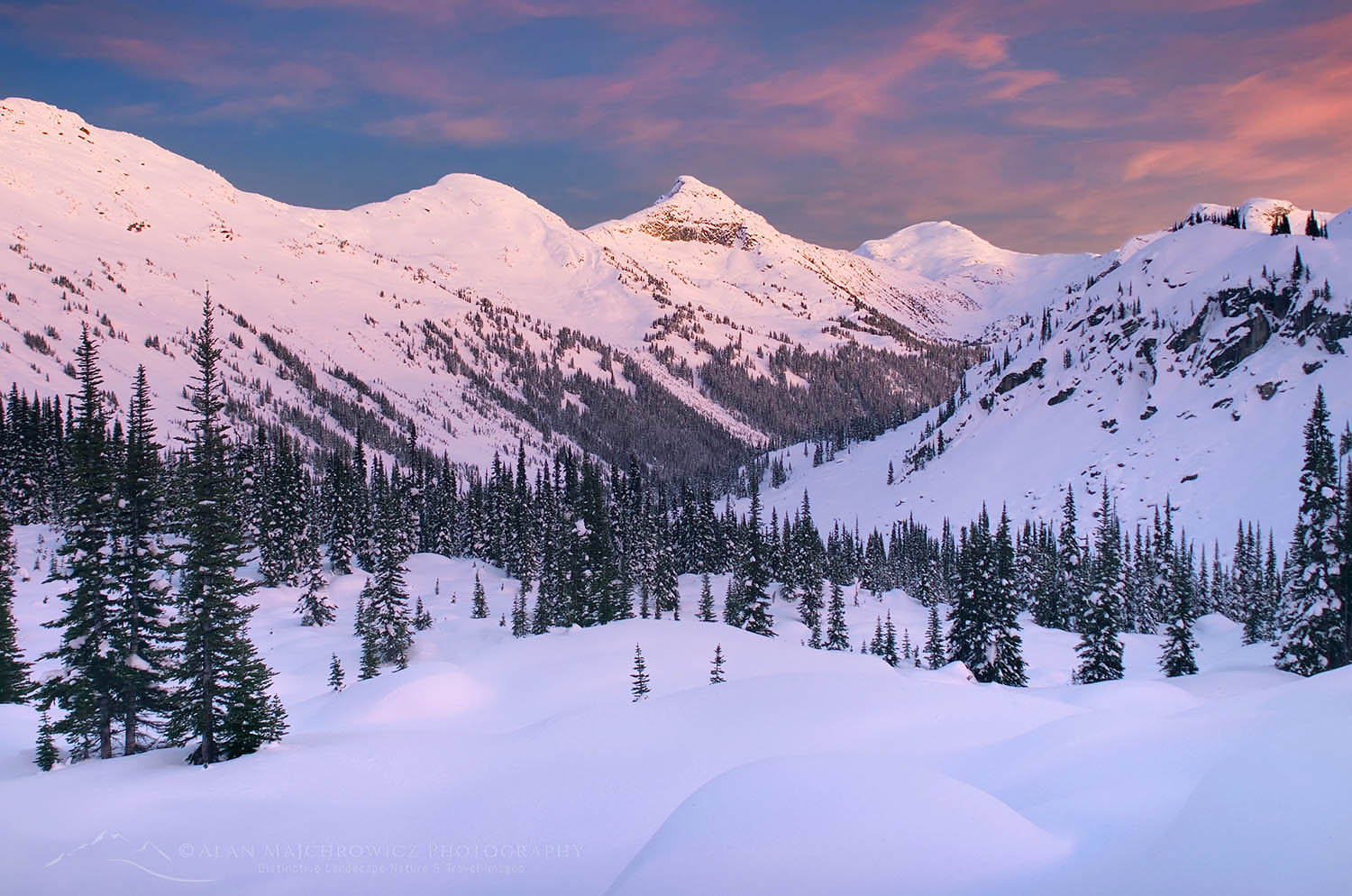
Marriott Basin, Coast Mountains British ColumbiaCoast Mountains Sunset British Columbia 50319  Purchase

Yesterday I finished editing and uploading all the new images from my recent Marriott Basin Coast Mountains Winter Photography trip in the Coast Mountains of British Columbia. On this trip, I was honored to be accompanied by Vancouver Photographer Adam Gibbs. I don’t know if Adam somehow brought along a good measure of luck since we enjoyed several outstanding displays of light during our stay.

Marriott Basin has been on my must-visit winter list for several years now. However, it has been routinely put off due to poor snow and weather conditions. This year, following a series of storms, forecasts showed an extended period of good weather. I knew it was time to make the trip.

Wendy Thompson Hut in winter Marriott Basin, Coast Mountains British ColumbiaWendy Thompson Hut Marriott Basin British Columbia 50424  Purchase

Skiing to the Wendy Thompson Hut in Marriott Basin

The base camp for this trip was to be the Wendy Thompson Hut, operated by the Whistler section of the Alpine Club of Canada. Wendy Thompson was a ski patroller and paramedic. She died tragically in 1995 at the age of 33 in a Medivac flight crash in the Queen Charlotte Islands. As a memorial and legacy to Wendy, her parents, and the ACC worked with volunteers to build this hut.

I routinely use skis to access many winter backcountry locations, but I’m not the most graceful or competent skier. Especially when carrying a multi-day pack loaded down with camera gear! Since we were staying at a hut I didn’t need to pack a tent or a few other items, however, my pack was still heavy with camera gear and extra winter clothing. Fortunately, due to several parties exiting the hut the day before we arrived, we didn’t need to break the trail through deep snow.

Wendy Thompson Hut in winter Marriott Basin, Coast Mountains British ColumbiaWendy Thompson Hut Marriott Basin British Columbia 50328  Purchase

The first mile or so is easy, traveling along a summer access road. Soon after the road ends the real work begins. Almost immediately the route tackles a steep forested headwall. This section is hard enough in summer, but in deep snow with a heavy pack and skis, it becomes a grueling task. Sooner than it seems the grade eases up and the forest begins to open up. From here to Lower Marriott Lake there are several areas of possible avalanche danger.

At the head of Lower Marriott Lake is the last steep section to climb before reaching the hut. After several hours of hard work, the sight of the hut is a welcome relief!

Marriott Basin in winter, Coast Mountains British Columbia CanadaWinter Alpenglow over Marriott Basin British Columbia 50319  Purchase

Evening Photography at Marriott Basin

Upon arriving at the hut, settling in, and quenching our thirst with hot drinks, it was time to scout out nearby photo locations. When we started earlier in the day the sun was shining in a blue sky with a few wisps of high-altitude clouds. However by the time we arrived at the hut clouds had moved in, turning the sky a solid grey. Fortunately, within a few minutes of checking out possible locations, the sun broke briefly through the clouds. The surrounding peaks were wearing a warm glow, and I knew it was time to get to work. I quickly managed to find a knoll close by that afforded an unobstructed view of the basin and peaks with some good foreground material to work with.

After setting up the first few photos it became apparent that the clouds were beginning to dissipate to create all the elements for an epic sunset and alpenglow. I quickly got into the zone and worked hard at composing as many different images as possible. Considering all the cloudless smoke-hazed locations I experienced last August and September this was payback time in a big way!

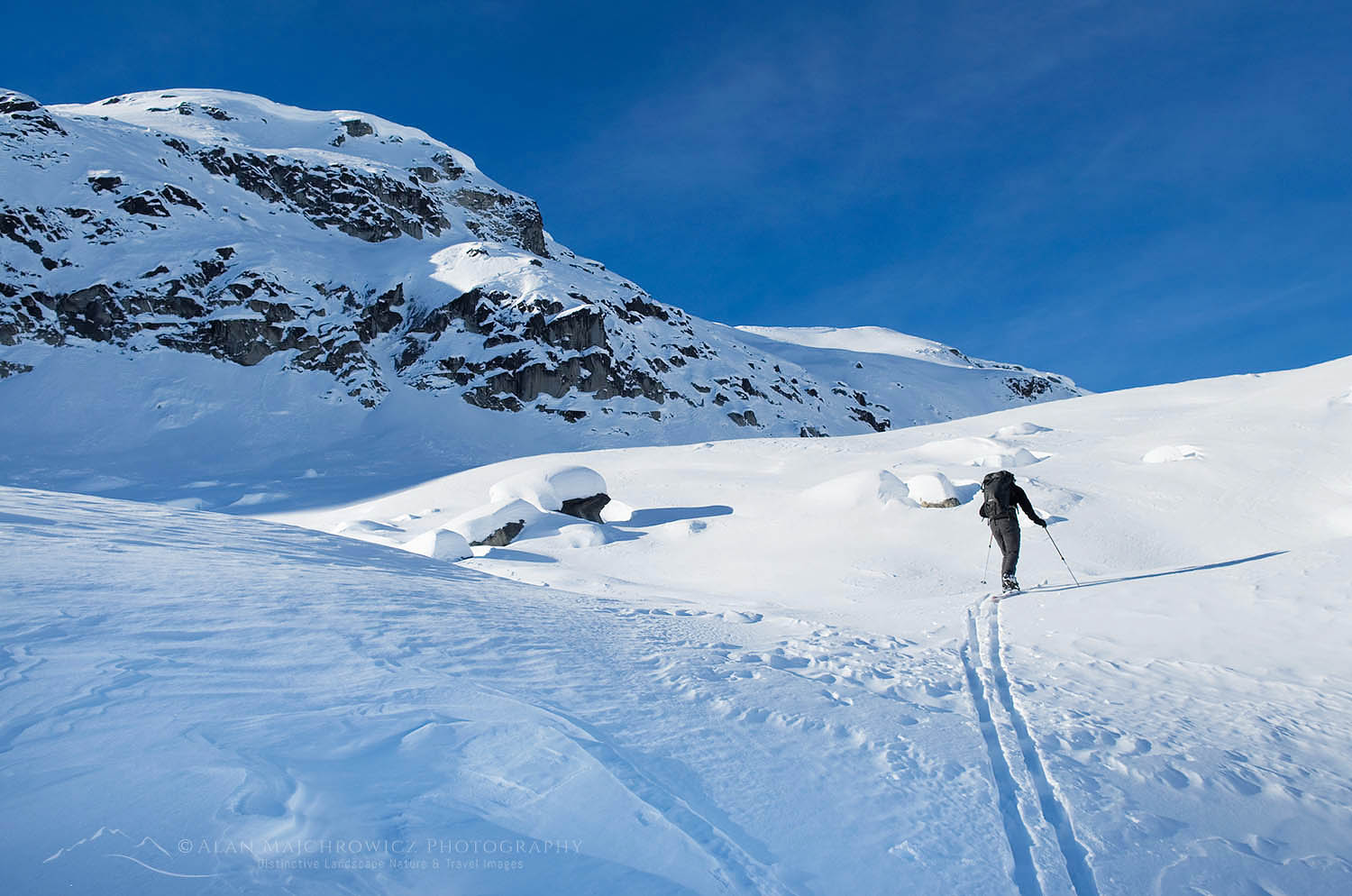
Backcountry ski touring in Upper Marriott Basin in winter, Coast Mountains British ColumbiaMarriott Basin ski touring 50336 Purchase

Touring  Upper Marriott Basin

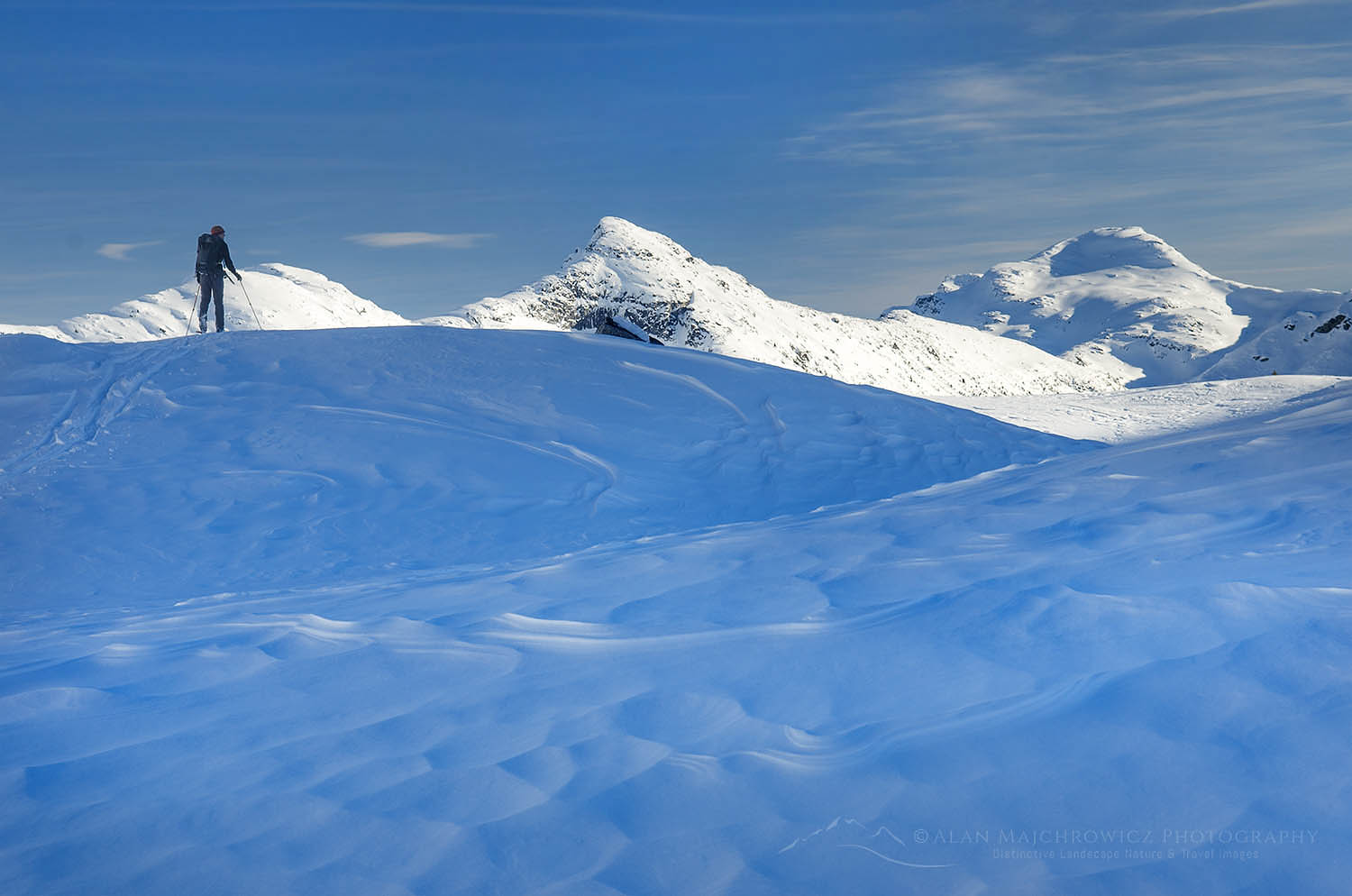
The next day Adam and I went on a short ski tour to explore the upper basins above the hut. Shortly above the hut the terrain enters a true alpine landscape with wide open views in all directions. Carrying only a day pack on mostly hard-packed snow the skiing was very pleasant, and I took my time to enjoy it all! In summer this area is filled with endless boulder fields and small lakes. However, in winter this is all covered in snow, which the wind has blown into beautiful shapes and patterns.

Backcountry ski touring in Upper Marriott Basin in winter, Coast Mountains British ColumbiaMarriott Basin ski touring 503353 Purchase

Mount Rohr, Coast Mountains British ColumbiaWinter sunset over Mount Rohr #50381

Later in the day the light once again put on a grand display. The clouds on this evening appeared stacked in layers as the setting sun illuminated them. This time I worked mainly with short to medium telephoto compositions to close in on the clouds behind the ridges so as not to duplicate the wide-angle photos from the first evening.

If You Go

The hut in Marriott Basin is a little less than 5 miles in with around 1600′ elevation to gain. The trailhead to the hut is at Cayoosh Pass about an hour northeast of Whistler. You must contact the ACC of Whistler to reserve a place for a nominal fee. They will also provide you with access details.

The hut is heated by a wood stove and is equipped with pots, pans, and eating utensils. However, you’ll need to provide your own stove and fuel to cook with. There is also electricity via solar panels and even USB outlets. Make sure you bring a good winter sleeping bag, in case there is no wood left for the stove or enough bodies to heat the hut.

In winter backcountry skis, snowshoes, or split-boards are your best options. Skinny cross-country skis are not a good option. Also, carefully consult the most recent avalanche reports before you go.

It also should be noted that the entire area surrounding Marriott Basin offers excellent ski touring opportunities. While this trip was primarily for landscape photography, there are countless downhill runs for skiers to explore. Everything from safe and easy, to life-threatening expert lines. An excellent map of the area is available through Backcountry Skiing Canada.

Upper Marriott Basin in winter, Coast Mountains British ColumbiaMarriott Basin Coast Range British Columbia 50356
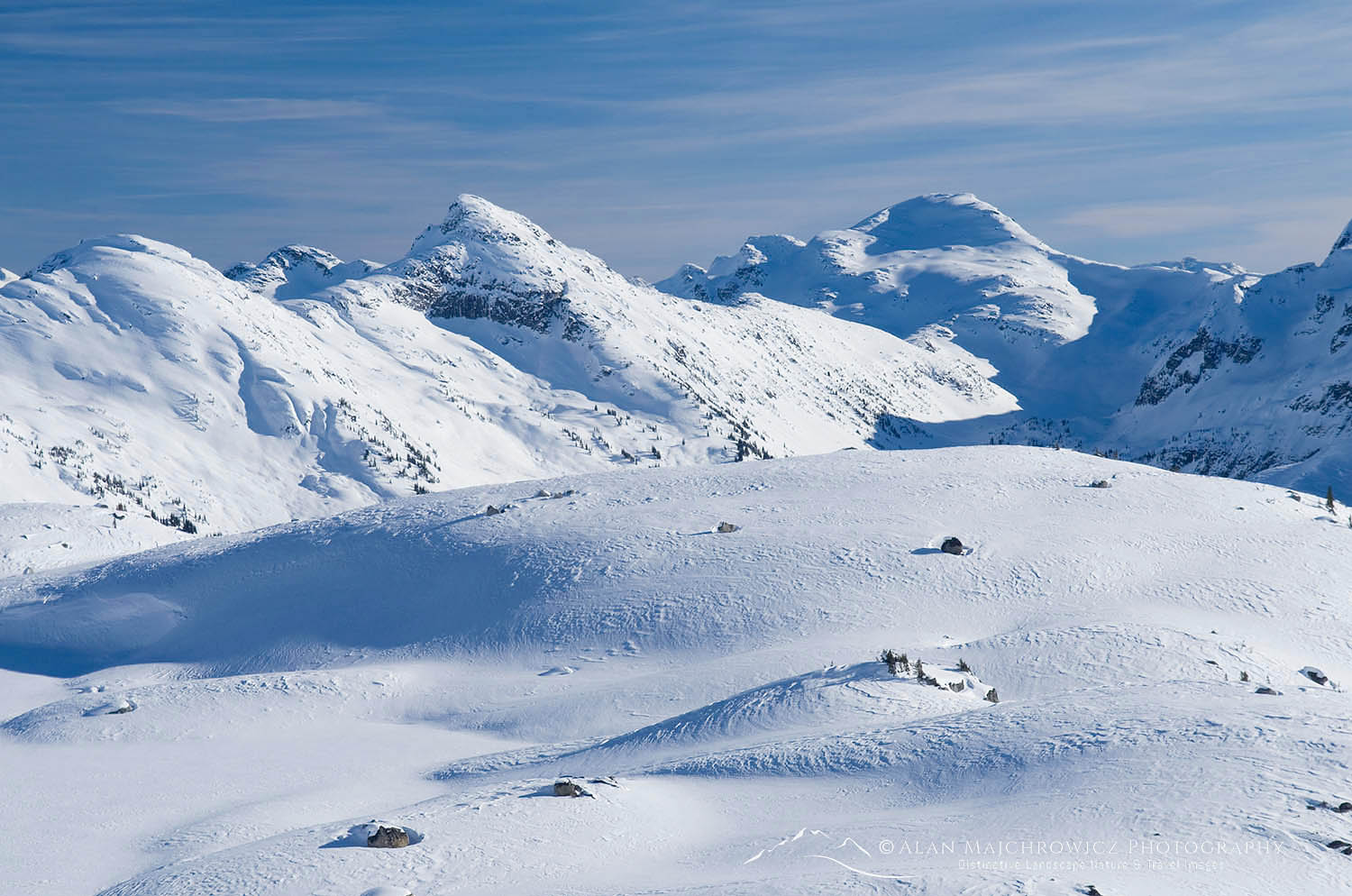
Upper Marriott Basin in winter, Coast Mountains British ColumbiaUpper Marriott Basin Coast Range British Columbia 50352
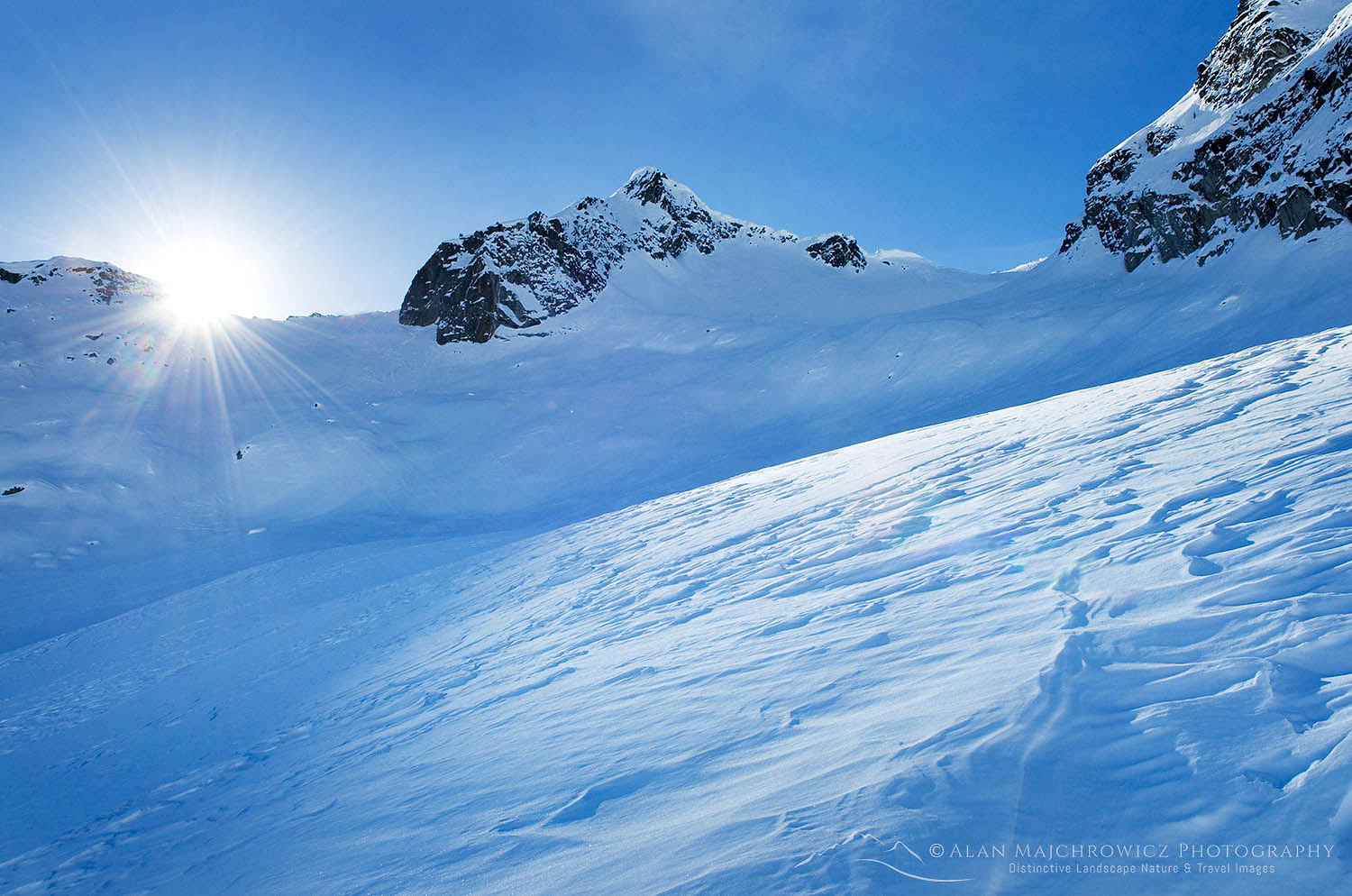
Upper Marriott Basin in winter, Coast Mountains British ColumbiaUpper Marriott Basin Coast Range British Columbia 50343

Marriott Basin Winter Photography